Stand at the end of a brick façade and look along its length. A wall that should be straight may have developed a shallow outward curve, sometimes accompanied by long horizontal cracks or small areas where the brickwork has separated at a corner.
In cavity construction, the condition of the connections behind that brick surface is one possible cause. HeliMate Australia supplies 8mm stainless steel remedial wall ties in 15 lengths, giving repair professionals a dedicated product range for restoring specified masonry connections where an assessed wall can be retained.
How Cavity Walls Stay Connected
A traditional double-brick cavity wall has separate inner and outer masonry leaves with a space between them. Wall ties link those leaves and help transfer lateral forces, allowing the wall assembly to resist pressures such as wind.
The cavity also forms part of the building’s moisture-management design, with flashings and weep holes helping redirect water. Ties must perform their structural function within that environment, often remaining concealed for decades after construction.
When the original connections deteriorate or become ineffective, the outer masonry may lose part of its intended restraint. Bowing, cracking or separation can follow, depending on the condition of the wall and the forces acting on it.
Why Hidden Steel Can Damage Visible Brickwork
Many older buildings contain metal connections exposed to moisture over long periods. Corrosion can reduce the steel remaining in a tie, while the expansion of rust can exert pressure on adjacent mortar and bricks.
That combination can produce two related problems: weakening of a connection and physical damage around the embedded metal. A façade may show horizontal cracking or bulging even though the most deteriorated part of a tie remains hidden inside masonry.
Western Australia’s guidance on pre-1990s brick buildings identifies corrosion of concealed wall ties and falling brickwork among structural safety concerns in older construction. It recommends suitably qualified inspection and maintenance to manage those risks.
The survey may therefore require investigation beyond the open cavity. Tie sections embedded within joints can have different corrosion conditions from the portions visible through a small inspection opening.
Read the Wall’s Shape Alongside Its Cracks
A bow is a change in alignment, while a crack shows where masonry has fractured or separated. Their combination can help a structural professional locate movement and decide what further investigation is required.
| Observation | What it adds to the assessment |
|---|---|
| A shallow outward curve across several courses | Indicates displacement requiring examination of connections and overall restraint |
| Long horizontal cracks | May reveal pressure or movement affecting bed joints and embedded ties |
| Rust staining or damaged mortar | Can indicate corrosion-related deterioration around metal components |
| Separation near a return wall | Directs attention towards junction connections and relative movement |
| Loose or displaced bricks | Raises concerns about immediate stability and falling masonry |
Significant bowing or loose masonry needs prompt structural assessment, with access controlled where there is a risk of falling material. The eventual repair depends on whether enough sound masonry remains for a designed stabilisation scheme.
Investigate the Ties and the Wall Behind Them
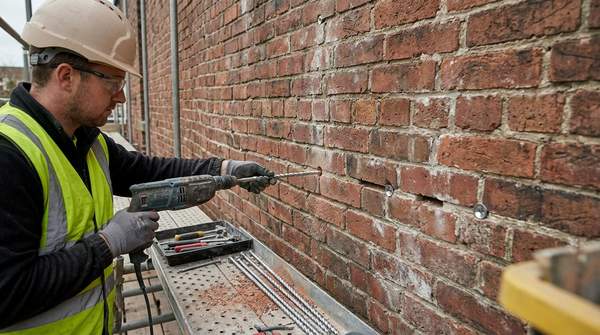
An effective assessment examines the cavity width, masonry thickness, existing connections and areas of visible deformation. Inspection cameras and selected access points may reveal the condition of accessible ties, while additional investigation can be needed around embedded ends.
The survey can also examine whether deterioration is concentrated near exposed openings or on elevations subject to greater moisture. A wall with mixed construction dates may contain different original tie types and cavity arrangements across separate sections.
Conditions outside the ties matter as well. Footing movement, inadequately restrained walls, deteriorated mortar and changes in loading can all influence bowing, so the engineer considers the complete wall assembly before designing the repair.
When Replacement Ties Form Part of the Answer
Where sound masonry remains and the assessed defect involves inadequate connections, a replacement-tie scheme may be appropriate. The engineer establishes the locations, required load transfer, fixing method and anchorage for the selected remedial system.
A more displaced wall can need additional stabilisation, selective rebuilding or other structural work. The scale of intervention follows the actual masonry condition, with any temporary support planned to protect the building during repairs.
The practical options can be grouped by the condition identified during the assessment:
| Assessed condition | Possible repair direction |
|---|---|
| Deteriorated connections in otherwise sound masonry | Engineered replacement or supplementary ties |
| Localised cracked or damaged bricks | Masonry repairs with an appropriate connection scheme |
| Significant distortion with retainable masonry | Designed stabilisation and controlled repair sequence |
| Unstable or severely displaced sections | Structural support and reconstruction as specified |
These are different repair scopes involving different amounts of work. HeliMate’s remedial ties are most directly associated with the connection elements of a suitable repair design.
Choose the Required HeliMate Tie Lengths
HeliMate’s remedial wall ties are 8mm in diameter and made from cold-pressed 316L stainless steel, a corrosion-resistant material for embedded masonry connections. The catalogue contains 15 lengths from 155mm through to 325mm, including closely spaced sizes such as 270mm, 275mm and 280mm.
Cavity width is one input into the overall required length. The tie must also engage sound masonry to the depth required by the selected fixing system, so an approved schedule identifies the exact product for each wall location.
That detailed range is useful where a building contains walls of different thicknesses or an extension constructed with another cavity arrangement. Contractors can keep tie quantities grouped by length and elevation, ensuring the specified connections remain identifiable throughout the work.
HeliMate offers trade-oriented pack options on representative tie listings. A project involving many fixing locations can therefore be organised around the products and quantities in the engineer’s connection schedule.
Protect the Wall’s Moisture-Management Details
The same water exposure that can corrode original ties may also affect mortar and the cavity’s drainage arrangement. An assessment may identify damaged flashings, blocked weep holes or deteriorated joints allowing water to remain near embedded components.
Those defects can be repaired alongside the connection work. Compatible masonry finishes and functioning drainage help preserve the conditions needed for a durable wall assembly after the new ties have been installed.
Other areas of cracked brickwork may also require reinforcement. HeliMate supplies 6mm and 8mm helical bars and compatible EzyBond or EzyGrout bedding materials for specified crack-stitching applications, allowing several different masonry product requirements to be sourced through the same specialist supplier.
Restore the Connections Behind the Façade
Bowing cavity brickwork calls for a structural assessment of the ties, masonry and remaining wall stability, with stainless steel remedial connections providing a repair route where the construction can be retained. Find the specified connection lengths in HeliMate Australia’s remedial wall-tie range and enquire about trade quantities for your next cavity-wall repair.