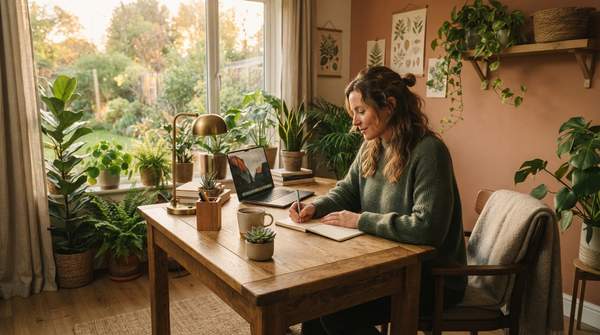
Biophilic design — the practice of integrating natural elements into your built environment — is one of the most accessible ways to improve a home office. Writers covering workplace design report that incorporating nature into a workspace can reduce stress, increase creativity, and improve concentration, with one home-office guide citing improvements of up to 15%. The good news for remote workers: you don't need an architect or a renovation. A desk repositioned toward a window, a few well-placed plants, and some natural textures can shift how your workspace feels and how you work in it.
Understanding Biophilic Design for Your Home Office
The term "biophilia" traces back to the 1960s, when the psychoanalyst Erich Fromm used it to describe our instinctive tendency to seek connections with nature, as Mark Johanson recounted in a BBC Worklife piece on workspace design. Biophilic design simply applies that instinct to the spaces we build: it prioritizes natural light, greenery, natural materials, views of nature, and even water, so that the environment supports the people inside it rather than working against them.
For a home office, this matters because your workspace is entirely yours to shape. As Home World Design, a home design publication, puts it, the home office has evolved from "a simple desk in the corner to a carefully designed space that promotes both productivity and well-being." The flexibility is the point: these principles can be adapted to any space, budget, or lifestyle, which makes them unusually well suited to personal workspaces rather than corporate ones.
One caution from the same BBC reporting: fashionable houseplants are merely the first step. The strongest results come from a more holistic, multisensory approach — light, color, texture, sound, and view working together rather than a single lonely fern on a shelf.
Why Biophilic Design Matters for Remote Workers
The benefits most relevant to someone working from home cluster around three outcomes: stress, focus, and creativity. An increasing body of evidence, as summarized in the BBC's reporting, shows that incorporating nature can help with decreasing stress and increasing productivity, creativity, and attention span. For remote workers, who often lack the natural variety of an office — the walk between rooms, the window seat in a café — these elements do quiet restorative work throughout the day.
Natural light deserves special attention. Workplace design writers note that access to natural light and views of nature can help regulate circadian rhythms and improve sleep patterns, which in turn supports alertness and productivity during the day. For a home worker whose commute is ten steps, light exposure may be the single most consequential biophilic element in the room.
Plants and greenery contribute a calmer baseline. Home World Design's guide links plants to reduced stress, improved focus, and a greater sense of calm in the workspace, while workplace design coverage from KiSP connects greenery to improved air quality and a more comfortable environment. Views of nature add another layer: even indirect or framed views can offer meaningful psychological restoration and stress reduction, according to Indoff's guidance on biophilic office practices. These benefits were observed in general office settings, but they apply just as well to a home workspace — arguably more so, since you control every variable.
Your Home Office Biophilic Assessment Checklist
Use this table to audit your workspace dimension by dimension. For each row, ask whether the element is present, partial, or missing — then take the suggested action. The goal is a personalized improvement plan, ordered from low-effort to higher-effort changes.
| Biophilic Element | Benefit for Home Office | Assessment Question | Actionable Tip |
|---|---|---|---|
| Natural Light | Regulates circadian rhythms, supporting sleep, alertness, and productivity (benefits observed in general office settings, applicable to home offices) | Do you work primarily by daylight, or by artificial light? | Position your workspace to maximize natural light; use sheer curtains or filtering materials to soften direct sunlight and avoid screen glare |
| Greenery & Plants | Reduces stress, improves focus, and creates calm; strategic placement and grouping enhance the effect | Can you see a plant from where you sit? | Add plants at your desk and in your sightline; group them rather than scattering singles |
| Natural Materials & Textures | Wood, stone, and woven fibers evoke the outdoors and strengthen your connection to nature | Are your desk, accessories, and surfaces mostly plastic and metal? | Introduce wood, stone, or woven fibers through furniture, decor, or desk accessories; favor textures and patterns that mimic natural forms |
| Views of Nature | Provides mental restoration and reduces stress; even indirect or framed views help | What do you see when you look up from your screen? | Face a window with a natural view if possible; otherwise use nature-inspired artwork, or position the desk toward moving elements like waving grass for dynamic visual stimuli |
| Water Elements | Calming sounds and visuals reduce stress and enhance focus | Is there any soothing sound in your workspace? | Add a small indoor fountain or aquarium if space and budget allow; a lower-effort alternative is a recorded water sound |
Score yourself honestly: a "missing" on any row is an improvement opportunity, not a failure. Most people find that two or three rows need attention, and the fixes rarely require more than an afternoon.
Actionable Tips for Integrating Nature into Your Workspace
Start with the lowest-effort, highest-impact moves. Rearranging your desk to let in as much natural light as possible is the first recommendation in leeb-architecture.com's workplace productivity guide, which also suggests using materials that filter light to soften direct sunlight. If your desk currently faces a wall, turning it toward a window is a free change that addresses both the light and view dimensions at once.
Next, layer in greenery and materials. Home World Design suggests creating green spaces with indoor plants or a dedicated green area where you can relax and recharge, and Indoff's guidance emphasizes that natural materials offer both visual and tactile connections to nature, making a space feel warm and welcoming. A wooden desk mat, a stone paperweight, or a woven basket for cables all count — the textures matter as much as the objects.
Finally, address what you hear and see. Water has a calming effect, and Indoff notes it can be integrated through indoor features like fountains or aquariums, bringing soothing sounds and visuals into the workspace. If a water feature isn't practical, position your view toward something dynamic — even grass moving outside a window provides gentle visual stimuli. And if a genuine natural view is impossible, nature-inspired artwork is a legitimate substitute, per Home World Design's guidance.
Throughout, remember the boundary of this approach: these are individual-scale changes. Nothing here requires structural renovation, and nothing here is botanical expertise — pick plants you can keep alive, and don't turn the office into a greenhouse project.
Sustaining Your Biophilic Home Office for Lasting Well-being
The decision, in the end, is simple: regularly assess and adjust your home office environment based on personal observations of productivity and well-being to maximize the benefits of biophilic design. Home World Design frames this as the real beauty of the approach — as you develop your nature-inspired office, you discover what works best for you, creating a personalized environment rather than a copied template.
To make that concrete, keep a simple work log for a few weeks after your changes. Note your focus, stress, and creative output each day, and compare against the weeks before. The measurable indicator is improved focus, reduced stress, and increased creativity reported in your personal work logs or self-assessments. If a change isn't earning its place — a plant you resent watering, a fountain you find distracting — adjust it. The environment serves the work, not the other way around, and the next milestone is simply your own logged evidence of whether it's working.
Sources
- Incorporating Natural Elements for Productivity in the Home Office — Home World Design
- How ‘biophilic’ design can create a better workspace — BBC
- Biophilic Office Design and Employee Wellness — KiSP
- Best Practices for Biophilic Design in Office Spaces — Indoff
- The Impact of Biophilic Design on Workplace Productivity — LEEB Architecture