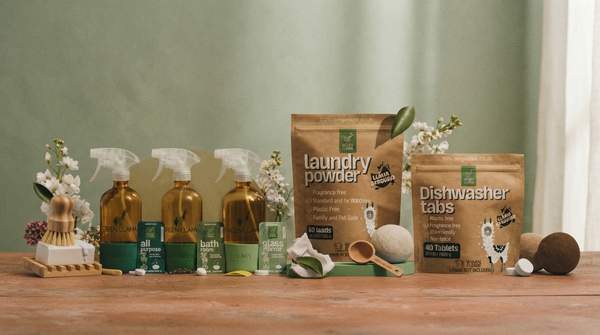
If you want a healthier home without a cabinet full of half-empty bottles, the evidence points to a surprisingly small kit: one surfactant-based concentrate for everyday grime and one EPA-registered disinfectant for germs. Green Planet Cleaning Services, a Bay Area company that has used non-toxic products in real homes since 2009, tested dozens of cleaners across every category and kept only a handful in its professional kit. Two of them stand out for covering nearly every household job: Branch Basics Concentrate for all-purpose cleaning and Seventh Generation Disinfecting Multi-Surface Cleaner for genuine disinfection. Understanding the difference between those two jobs — and what the certifications on their labels actually verify — is the whole game.
Understanding Non-Toxic Cleaning: All-Purpose vs. Disinfectant
The most common mistake in non-toxic cleaning is assuming one product can do everything. It can't. Cleaning and disinfecting are different mechanisms with different evidence behind them. A cleaner lifts dirt, grease, and grime off a surface. A disinfectant kills pathogens, and in the United States that claim must be registered with the EPA to be legitimate.
Green Planet Cleaning's testers are blunt about this distinction: their top-rated all-purpose product, Branch Basics Concentrate, is not an EPA-registered disinfectant. It excels at grease, soap scum, and general grime, but it makes no germ-killing claim. Their go-to disinfectant, Seventh Generation's Multi-Surface Cleaner, is the only non-toxic EPA-registered disinfectant in their test, with a 99.99% kill claim against its listed pathogens. Neither replaces the other — which is exactly why a two-product kit beats a single "miracle" bottle.
Top Non-Toxic Cleaners for Everyday Tasks
Branch Basics Concentrate is the workhorse. One 33-ounce bottle (about $49) makes 25 or more bottles of cleaner at different dilutions, and Green Planet Cleaning's verdict is that it's "the best non-toxic cleaning product we've tested, period." Its certifications include EWG Verified, MADE SAFE, Leaping Bunny, and CARB compliance — badges we'll decode below.
What actually does the cleaning? Plant-derived surfactants, chiefly decyl glucoside (from corn) and coco-glucoside (from coconut). Consumer Reports, reviewing the starter kit, lists the full formula: purified water, decyl glucoside, organic chamomile flower extract, coco-glucoside, sodium citrate, sodium bicarbonate, and sodium phytate — all plant- and mineral-based, with no sulfates, chlorine, phosphates, phthalates, parabens, or volatile organic compounds. Surfactants work by reducing surface tension so water can lift dirt away.
That mechanism has a practical edge over castile soap in hard water. As Lara Voss explains at NonToxicLab, soap reacts with minerals in hard water — which affects roughly 85% of US households, by her account — to leave a film on surfaces, while surfactant-based cleaners don't. The trade-offs are real, though: the concentrate has a high upfront cost (though low per-use), and you have to dilute it into separate bottles yourself. A reviewer at The Good Trade who has used it for years praises how it replaces a pile of miscellaneous products with one streamlined system.
Top Non-Toxic Disinfectants for Pathogen Control
When someone in the house has been sick, or you're cleaning bathrooms and food-prep surfaces, you need a different tool. Seventh Generation Disinfecting Multi-Surface Cleaner (about $6 for 26 ounces) is Green Planet Cleaning's pick, and the reasoning is specific: it was the only non-toxic product in their test carrying an EPA-registered disinfectant claim.
Its active ingredient is thymol, a plant-derived compound from thyme, responsible for the disinfecting action and the noticeably herbal scent. Beyond killing 99.99% of its listed pathogens, it holds EPA Safer Choice and CARB compliance certifications. The testers note it isn't as effective on heavy grease as Branch Basics — so it's a specialist, not a daily driver. Keep it for after illness, bathrooms, and food-contact surfaces, and let the concentrate handle routine wipedowns.
Non-Toxic Cleaner Comparison: Choose Your Tool for the Task
Here is the side-by-side that turns those two products into a working kit. The key line to internalize is the task column: one lifts grime, the other kills germs, and no certification on the first bottle changes that.
| Product | Primary Task | Key Technology/Ingredient | Certifications | Key Limitation |
|---|---|---|---|---|
| Branch Basics Concentrate | All-purpose cleaning, degreasing, laundry, general grime | Plant-derived surfactants (decyl glucoside, coco-glucoside) reduce surface tension and lift dirt without soap-scum film in hard water | EWG Verified, MADE SAFE, Leaping Bunny, CARB Compliant | Not an EPA-registered disinfectant; requires dilution into separate bottles; high upfront cost |
| Seventh Generation Disinfecting Multi-Surface Cleaner | Disinfecting surfaces after illness, in bathrooms, on food-prep areas | Thymol, a plant-derived active ingredient that kills bacteria and viruses | EPA Safer Choice, EPA Registered Disinfectant, CARB Compliant | Not as effective on heavy grease; noticeable thyme scent |
Read across the rows and the decision boundary appears on its own: for daily wipedowns, counters, and greasy stovetops, the surfactant concentrate is the better tool. When a surface needs to be germ-free — a sick household member's bathroom, a cutting board after raw chicken — only the registered disinfectant makes that claim, and it's the one to reach for.
Decoding 'Green' and 'Safe' Cleaning Product Certifications
Certifications are where marketing and evidence most often blur, so here's what each common badge actually means — and what it doesn't. Zenda Guide's breakdown is useful precisely because it separates ingredient-preference certifications from efficacy registrations.
- EPA Safer Choice: Meaningful comparative evidence that ingredients are safer for human health and the environment, as evaluated by the EPA — but it is not a "certified non-toxic" promise for every use, and it says nothing about germ-killing efficacy.
- EPA Registered Disinfectant: A different category entirely. This is a registration of a specific product's proven ability to kill the pathogens listed on its label. It doesn't necessarily imply broader environmental or human-health safety beyond that disinfectant use.
- EWG Verified and MADE SAFE: Third-party programs applying their own ingredient and transparency standards to a qualifying exact product. They strengthen a product's record but don't replace performance evidence or usage directions.
- USDA Certified Biobased: Verifies the percentage of renewable biological carbon under the program's method. USDA itself notes that a higher biobased percentage doesn't necessarily establish better safety, performance, or total environmental impact.
Branch Basics itself, in an ingredient explainer authored by Marilee Nelson, warns that "green," "organic," or "from nature" on a label is not enough — the company's own marketing aside, that caution is the right instinct. A badge tells you what was verified; only the task and the directions tell you what the product will do.
Making Informed Choices for a Healthier Home
To effectively maintain a healthier home, select non-toxic cleaning products based on their primary task — using surfactant-based cleaners like Branch Basics Concentrate for general grime, grease, and laundry, and EPA-registered, thymol-based disinfectants like Seventh Generation's Multi-Surface Cleaner when pathogens are the concern — and verify claims by understanding the relevant certifications rather than trusting front-of-label language.
You'll know you've got it right when you can do two things: pick the correct bottle for the job in front of you without hesitating over whether your all-purpose cleaner is "also a disinfectant" (it isn't), and explain to a skeptical housemate what at least two of those badges — say, EPA Safer Choice versus EPA Registered Disinfectant — actually verify. That's the measurable outcome: a two-product kit, chosen on mechanism and certification rather than marketing, that covers both the daily wipedown and the after-illness deep clean.
Sources
- Best Non-Toxic Cleaning Products (Tested by Pro Cleaners) — Green Planet Cleaning Services
- Is the Branch Basics Premium Starter Kit Really a Replacement for All… — Consumer Reports
- Branch Basics vs Dr. Bronner's: Two Very Different Approaches to Clean — NonToxicLab
- I Tested 15+ Natural And Nontoxic Cleaning Products — The Good Trade
- 8 Non-Toxic Cleaning Products, Matched to Real Household Tasks — Zenda Guide
- Is Branch Basics Safe? Ingredients, Certifications & FAQs Explained