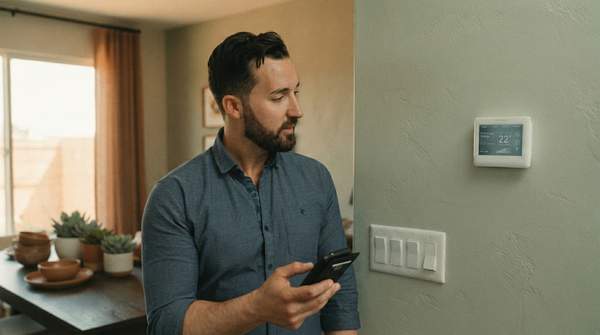
Smart home technology can genuinely support well-being, but the decision to adopt it is rarely a simple yes. Research on smart home appliance adoption, published in the journal Energy Informatics, identifies convenience and connectedness as the primary driver for adoption, while concerns about device privacy risks act as a persistent counterweight. The practical question for most households is not whether a device is impressive, but whether its specific wellness benefit justifies its specific data exposure and learning burden. This article offers a reusable framework for answering that question, using device categories as illustrations rather than endorsing particular products.
Understanding Smart Home Wellness: Beyond Convenience
"Wellness" in a smart home context extends well past health gadgets. A survey of smart home security technologies published through the National Center for Biotechnology Information describes systems that sense, assess, and respond to threats: Ring's doorbell-camera pairing, iControl's combination of camera, motion detection, sound detection, and an intruder siren, and SmartThings' camera monitoring paired with remote-controlled door locks. These are safety devices, but their contribution to well-being is psychological as much as functional, offering residents a sense of security and the ability to act on alerts from a distance.
That sense of security is a documented wellness outcome in its own right. Research from the AgeTech Collaborative from AARP, drawing on participant discussions with older adults and their caregivers, found that devices like doorbells and video conferencing equipment "could provide comfort and a sense of security from a distance," and that health monitoring devices were viewed as essential for preventing bad outcomes. Well-being, in other words, spans direct health monitoring, safety, convenience, and financial savings through energy management.
The Spectrum of Wellness Benefits
The clearest way to categorize the benefits is by how directly they touch your health. At the most direct end sits sleep tracking: PCMag's testing of smart displays describes the second-generation Nest Hub, whose sensors track sleep, overnight respiration rate, coughing, and snoring, along with light and temperature changes in the room, without a camera or a wearable device, then offer insights to improve sleep.
A step less direct are safety functions. The smart home security survey notes research by Zhuang and colleagues using Gaussian mixture models to analyze single-microphone audio data and detect human falls, a function aimed at protecting vulnerable residents. AARP's AgeTech research found care recipients believed such monitoring could give them more control over their daily lives, while caregivers saw devices that removed tasks from their plates as conveniences even when care recipients couldn't operate them independently.
At the indirect end sit convenience and cost savings. The Energy Informatics adoption study reports that smart home appliances contribute substantially to reducing energy consumption, citing research showing 5 to 15 percent energy reductions achievable through direct feedback options from smart appliances. The same study found that perceived financial benefits influence users' behavioral intentions, meaning the money dimension is itself part of the wellness appeal.