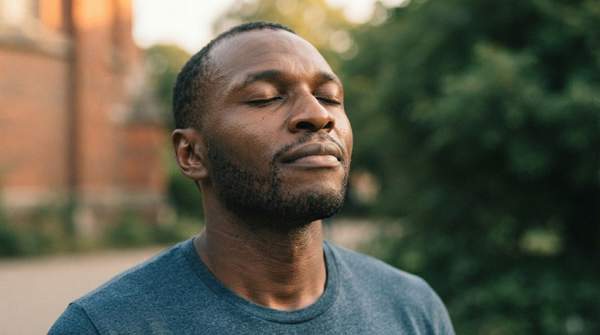
Your breath is the one lever of the autonomic nervous system you can pull by hand. When you slow your breathing—especially the exhale—you stimulate the vagus nerve, which shifts the body out of the sympathetic "fight or flight" state and into the parasympathetic "rest and digest" state. That shift is measurable: heart rate eases, heart rate variability improves, and stress hormones like cortisol fall. Here is the physiological chain behind it, and how two well-known techniques put it to work.
Understanding Your Nervous System: The Stress Response
When something feels like a threat—out of the ordinary, or out of your control—your body does not ask permission. A vagus nerve that runs from the base of the brain and branches out to the organs acts, in the words of Yale School of Medicine's Karyn Bailey, as "a conduit of chemicals/hormones that are activated automatically/reflexively by our sympathetic nervous system and result in the stress response that is often described as the fight or flight response."
That response raises heart rate, blood pressure and alertness, as a physician-reviewed overview from Ubie outlines. It is useful in short bursts and draining when it never switches off. The counterweight is the parasympathetic nervous system, the branch that handles recovery and repair. Deep breathing and relaxation activate it, and as the University of Toledo's counseling guidance puts it, this "sends a signal to your brain to tell the anxious part that you're safe and don't need to use the fight, flight, or freeze response"—freeing up mental energy rather than spending it on alarm.
The Vagus Nerve: Your Body's Calming Pathway
The vagus nerve is the bridge between breath and calm. Breathing is not merely a mechanical process, as a News-Medical explainer by Vijay Kumar Malesu describes, but "a powerful modulator of the autonomic nervous system, influencing heart rate, emotional state, and overall physiological balance." Because the vagus nerve carries traffic between the brain, lungs and heart, changes in respiratory rhythm feed directly into that regulatory loop.
When practiced regularly, breathwork promotes parasympathetic activation, enhancing vagal tone and heart rate variability—markers associated with better emotional resilience and cardiovascular health. The two branches are always negotiating: the question is not whether the nervous system responds to breath, but which direction your breathing pattern pushes it.
The Physiological Cascade: How Breath Transforms Stress
The mechanics matter at the level of each inhale and exhale. A slow, deep inhalation briefly reduces vagal activity—the nerve's braking action eases momentarily—before a slow, prolonged exhalation restores it and stimulates baroreceptors, the pressure sensors that help regulate cardiovascular balance. That exhale is the crucial act for activating the parasympathetic response.
This effect contributes to a decrease in heart rate and an increase in heart rate variability. Over time, reviews of slow breathing studies—covering rates at or below six breaths per minute, diaphragmatic activation, nasal breathing and breath holds—report significant improvements in vagal tone, HRV, parasympathetic activity and emotional control, alongside reductions in cortisol, anxiety, stress and PTSD symptoms. A meta-analysis of randomized controlled trials, cited in the News-Medical review, found breathwork significantly reduced self-reported stress, anxiety and depression compared with controls.
The Breath-Body Connection: A Physiological Pathway
Tracing the full pathway from a single controlled breath to a calmer nervous system looks like this:
| Breathing action | Immediate physiological effect | Nervous system shift | Key physiological outcome |
|---|---|---|---|
| Slow, deep inhalation | Briefly reduces vagal activity | Momentary sympathetic lean | A short effect, reversed on the exhale |
| Slow, prolonged exhalation | Restores vagal activity and stimulates baroreceptors | Shifts toward parasympathetic dominance | Lower heart rate; higher HRV |
| Controlled breathing, generally | Vagus nerve activation | Counters the fight-or-flight response | Improved HRV; lower cortisol |
| Resonant/coherent breathing (about 6 breaths/min) | Slows respiratory rhythm to align with cardiovascular rhythms | Sustained parasympathetic emphasis | Maximized HRV and vagal tone |
| Alternate nostril breathing (Nadi Shodhana) | Unilateral airflow may bias autonomic activity | Balances the two branches toward calm | Promotes parasympathetic dominance and mental clarity |
The sequence is the point: action first, then vagal stimulation, then a shift in autonomic balance, then the measurable outcomes. Each row of the cascade is trainable, and each one responds within minutes to hours of a session, according to the physician-reviewed Ubie overview.
Key Breathwork Techniques and Their Mechanisms
Resonant or coherent breathing asks you to breathe at roughly six breaths per minute—about a five-second inhale and five-second exhale—often for 10 to 20 minutes to enhance heart rate variability. Because the rate is deliberately slow, it maximizes the exhale-driven vagal restoration described above, making it the most direct application of the core mechanism.
Alternate nostril breathing works differently. You close the right nostril and inhale through the left, then close the left and exhale through the right, and reverse the pattern; it is often used in yoga to promote calm and mental clarity. Its distinctive lever is lateralization. A pilot study published through PMC notes that experiments from the 1980s showed the nasal cycle is regulated by the autonomic nervous system, and that since most autonomic nerve fibers are lateralized, the dominant nostril corresponds to sympathetic activation in the corresponding side of the body and central nervous system. The evidence further suggests left nostril breathing may increase parasympathetic activity while right nostril breathing may lean sympathetic—which offers a plausible mechanism for how the alternation balances autonomic activity.
One caveat keeps both techniques honest: a review of long-term mental health outcomes proposes that various breathwork techniques converge toward similar psychological benefits through their shared influence on autonomic modulation, while cautioning that differences between techniques and their short-term physiological mechanisms of action remain. Choose the one you will actually do.
Harnessing Your Breath for Daily Calm
The practical decision is to consciously integrate controlled breathing techniques into daily routines to actively manage stress and enhance mental clarity. Both techniques share the same physiology—a slowing rhythm, an extended exhale, a vagus nerve that reports safety back to the brain—so a few quiet minutes, seated and safe, is enough to begin.
Monitor for a noticeable reduction in perceived stress, improved focus, and a greater sense of calm during challenging situations. Those are the markers the evidence supports, and they are the ones you can check yourself, day after day.
Two boundaries deserve the last word. This explains the general physiological mechanisms of breathwork for stress reduction; it is not medical advice or treatment for any specific condition. And it covers the autonomic effects only—not the full psychological or spiritual dimensions of breathwork traditions. Practice in a safe environment, and let the exhale do its quiet work.
Sources
- The Science Behind Breathwork and Stress Reduction — News-Medical
- The Power of the Breath — Yale School of Medicine
- Stop Doing Breathwork Wrong: Doctor’s Nervous System Truths — Ubiehealth
- Deep Breathing and Relaxation — Utoledo
- The Influence of Breathing on the Central Nervous System - PMC
- Breathing Right… or Left! The Effects of Unilateral Nostril Breathing on Psychological… — PMC
- The A52 Breath Method: A Narrative Review of Breathwork for Mental Health and Stress Resilience - PMC