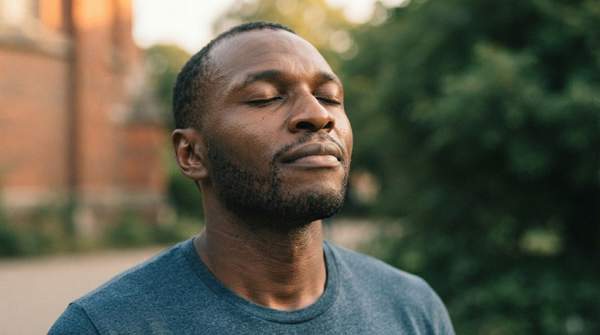
Slow, controlled breathing works because it gives you direct access to the part of your nervous system that runs your stress response. A systematic review of slow-breathing research found that these techniques promote a predominance of the parasympathetic ("rest and digest") system over the sympathetic ("fight or flight") system, mediated by activity in the vagus nerve. In other words, the breath is one of the few conscious levers on an otherwise involuntary system—and research points to a rate of around six breaths per minute as the sweet spot for stimulating that pathway.
The Autonomic Nervous System: Your Body's Stress Regulator
Your autonomic nervous system runs everything you don't have to think about: heart rate, blood pressure, digestion, and breathing itself. As the BBC's David Cox has explained, drawing on the research literature, it has distinct divisions that pull in opposite directions. The sympathetic nervous system activates the body's "fight or flight" response in high-arousal or dangerous situations, increasing adrenaline, blood pressure, and heart rate. The parasympathetic nervous system triggers "rest and digest" functions, calming the body and focusing on processes such as digestion.
Yale School of Medicine's Karyn Bailey, a licensed clinical social worker, describes the stress response as beginning when the vagus nerve—which runs from the base of the brain and branches out to the organs—serves as a conduit for chemicals and hormones activated reflexively by the sympathetic nervous system. This is the body's natural response to perceived threats. The problem in modern life is that financial pressure, traffic, and work anxiety can keep that threat system chronically engaged, which is where deliberate breathing enters the picture.
Breathwork vs. Mindfulness: Active Control vs. Passive Observation
Before using breathwork, it helps to know what it actually is—and how it differs from practices it's often confused with. A meta-analysis of randomized controlled trials published in Scientific Reports by Guy Fincham and colleagues draws the line clearly: traditional mindfulness-based programs involve meditation that uses the breath as an object of awareness, not voluntary regulation of respiration. Breathwork, by contrast, means actively changing the rhythm, depth, and pattern of your breathing.
This distinction matters for what the physiology can do. The same meta-analysis notes that a separate review found insufficient evidence that mindfulness or meditation improves vagally mediated heart rate variability, and that more well-designed trials without high risk of bias are needed to clarify contemplative practices' impact on this metric. A study on brief structured respiration practices, published by a research team examining voluntary breathing and mood, similarly reasoned that deliberate breathing practices may influence brain function partly through vagus nerve pathways—mechanisms that passive observation of the breath does not directly engage. Breathwork speaks to the nervous system through the body; mindfulness observes the body with the mind.
The Vagus Nerve: The Highway to Calm
The vagus nerve is the main pathway of the parasympathetic nervous system, and it is strikingly lopsided in its traffic. According to the Fincham team's meta-analysis, roughly 80 percent of vagus nerve fibers transmit messages from the body to the brain, not the other way around. That means your bodily state—heart rate, breathing pattern, organ signals—is continuously reporting upward and shaping your mental state. Polyvagal Theory, as they describe it, posits that the vagal nerves are major channels for this bidirectional body-brain communication.
The systematic review on slow breathing adds a key detail about how information travels: the vagus nerve transmits interoceptive information from the gastrointestinal, cardiovascular, and pulmonary systems to the central nervous system through the Nucleus of the Tractus Solitarius in the brainstem. Your lungs are wired into this loop. When you slow your breath, you are sending a signal up this highway—and the neurovisceral integration model, cited in the same meta-analysis, holds that high vagal tone is associated with improved health along with emotional and cognitive functioning.
How Slow Breathing Activates the 'Rest and Digest' Response
The mechanism comes down to rate. The systematic review reports that heart rate variability (HRV)—a marker of vagal activity—is highly dependent on respiration frequency, increasing as the breath slows. Around six breaths per minute is the rate most frequently identified in the research as optimal for maximizing HRV and stimulating the vagus nerve in healthy adults, a pace sometimes called resonant frequency breathing. At this rhythm, vagal activity promotes parasympathetic predominance, shifting the body away from the sympathetic state.
There is also a two-way relationship between breathing and the autonomic nervous system, as Cox's reporting describes: breathing quickly and shallowly through the mouth tends to activate the sympathetic system, signaling stress, while slow breathing engages the calming branch. This is why the general principle of breathwork is simply slowing down—not mastering a complicated named technique.
The Breath-Body Connection: A Pathway to Calm
The full chain of events, from a single conscious decision to a calmer state, looks like this:
| Step | What happens | The evidence behind it |
|---|---|---|
| 1. Stress response (starting point) | The sympathetic nervous system prepares the body for action, raising heart rate and arousal | This is the body's natural response to perceived threats |
| 2. Conscious slow breathing | You deliberately slow your breathing rate—around six breaths per minute is the researched optimum | HRV increases as breath slows; this rate is known as resonant frequency breathing in healthy adults |
| 3. Vagus nerve stimulation | Slow, controlled breathing activates the vagus nerve, the main body-to-brain communication channel | Approximately 80% of vagus nerve fibers transmit signals from body to brain |
| 4. Signal to the brainstem | Interoceptive information from the lungs and cardiovascular system reaches the brain via the Nucleus of the Tractus Solitarius | Documented in the systematic review of slow breathing |
| 5. Parasympathetic shift | Vagal activity promotes parasympathetic predominance, initiating "rest and digest" | This shifts the body away from a sympathetic state |
| 6. Resulting calm | Arousal pathways are dampened, producing calmness and emotional regulation | This is a direct result of the physiological shift |
Read from top to bottom, the table shows why breathwork is not a placebo or a metaphor: each step is a measurable physiological event, and the whole sequence is triggered by a voluntary action—slowing your breath—that you can take at any moment.
The Science of Emotional Regulation Through Breath
The systematic review concludes that slow breathing techniques enhance interactions between autonomic, cerebral, and psychological flexibility, linking parasympathetic and central nervous system activities related to both emotional control and well-being. Reporting by Vijay Kumar Malesu for News-Medical adds that a meta-analysis of randomized controlled trials confirms breathwork significantly reduces self-reported stress, anxiety, and depression levels compared to controls.
Two honest caveats belong here. First, research is ongoing: the Fincham team's meta-analysis itself flags that more well-designed randomized controlled trials are needed in related areas, such as the effects of contemplative practices on HRV and cortisol. Second, breathwork is a self-regulation tool, not a treatment—none of this evidence supports replacing professional mental health care with breathing exercises.
Empowering Your Stress Response Through Breath
Readers can confidently apply slow, controlled breathing techniques, particularly those targeting a rate of around 6 breaths per minute, to actively engage their parasympathetic nervous system and mitigate stress. The measurable indicator is a noticeable reduction in feelings of anxiety or physiological arousal, such as a calmer heart rate or a sense of relaxation, during or after practicing controlled breathing. That is the check you can run yourself: slow your breath toward six cycles per minute for a few minutes, and notice whether your body settles. If it does, you have just watched your vagus nerve do its work.
Sources
- How Breath-Control Can Change Your Life: A Systematic Review on Psycho-Physiological Correlates of Slow Breathing - PMC
- These breathing techniques could reduce your stress in minutes — BBC
- The Power of the Breath — Yale School of Medicine
- Effect of breathwork on stress and mental health: A meta-analysis of randomised-controlled trials - Scientific Reports — Nature
- Brief structured respiration practices enhance mood and reduce physiological arousal - PMC
- The Science Behind Breathwork and Stress Reduction — News-Medical