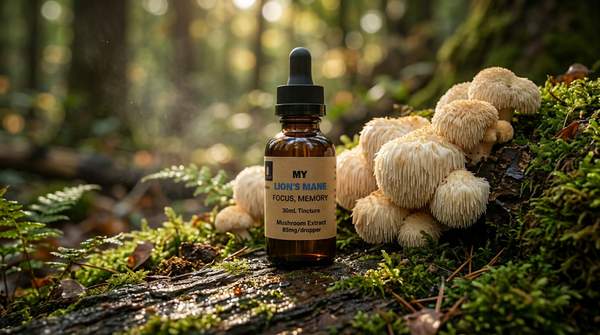
At first glance, Lion’s Mane looks like something the forest has hung out to dry. A cluster of white, downward-pointing spines spills from a tree trunk, with no cap or stalk to match the mushrooms most people know. Seen from a distance, it could be a pom-pom, a beard, or a small frozen waterfall.
And yes, people eat this extraordinary-looking thing. Lion’s Mane has a place in specialty kitchens as well as in functional mushroom collections. The same shaggy species turns up in a very different form at My Mushroom: a 30 mL Lion’s Mane Mushroom Tincture, easy to recognize if you first met the fungus on a woodland walk, in a recipe, or through a photograph you couldn’t quite believe.
A Mushroom With Teeth Instead of Gills
Lion’s Mane, Hericium erinaceus, grows on hardwood and produces spines that point downward from its pale fruiting body. Many familiar mushrooms release spores from gills beneath their caps. Lion’s Mane produces them on those hanging teeth, giving the fungus its wonderfully unruly silhouette.
Its appearance has inspired other names, including bearded tooth mushroom and pom-pom mushroom. The names are descriptive enough that someone seeing a mature specimen for the first time might invent a similar one. There is something charming about a fungus that looks as though it belongs in both a field guide and a costume shop.
The white cluster is only the visible reproductive part of the organism. A network of fungal filaments, known as mycelium, grows through the wood and obtains nutrients. On a tree, the two parts belong to one living system, even though only the spines tend to make it into photographs.
Cornell University has investigated cultivating Lion’s Mane on hardwood logs as a specialty forest crop. Researchers studied different strains and the timing of their production on inoculated wood. It is an absorbing piece of mushroom agriculture: growing a dramatic white fungus on a log requires far more patience than putting a pot of herbs on the windowsill.
The Mushroom That Chefs Actually Want to Cook
Lion’s Mane has a distinction among familiar functional fungi: its fruiting body is valued as a culinary ingredient. The flesh develops a fibrous consistency, and cooks sometimes compare the texture to crab or lobster after preparation. That comparison is about the mouthfeel and cooking possibilities, not a claim that a mushroom tastes exactly like seafood.
Its structure gives cooks something to work with. Pieces can be torn apart, browned, or shaped into portions that emphasize texture. The spines that look so delicate on the tree surround a substantial body that behaves differently in the pan from a thin, woody bracket fungus.
Cornell’s research also describes Lion’s Mane as desirable to chefs and examines the potential of producing it as a specialty crop. There is an appealing contrast between the care required to cultivate it and the surprising simplicity of the final ingredient: a strange white mushroom becomes dinner.
This culinary life makes Lion’s Mane an unusually welcoming introduction to the wider mushroom world. A person may first encounter it in a recipe, spot a photograph of it growing on a beech tree, and later notice the same name in a functional mushroom collection. Each encounter begins with a different kind of curiosity.
A Different Form of the Same Fascination
The Lion’s Mane Mushroom Tincture at My Mushroom is a 30 mL liquid product priced at CA$32.00. Its official description states 85 mg of mushroom extract per dropper and presents the formula around focus and memory-oriented wellness interests. The bottle is a completely different experience from cooking a fresh mushroom, but the species name gives people a familiar thread to follow.
A small dropper bottle has its own appeal within a collection. It takes up little visual space, carries a clearly identified mushroom name, and sits beside other liquid products named for Reishi, Cordyceps, Chaga, and Turkey Tail. You do not need to know the entire functional-mushroom vocabulary to find the fungus that first caught your attention.
Here, the 85 mg-per-dropper statement refers to the declared mushroom-extract amount, while the 30 mL figure describes the liquid volume of the bottle. The details suit a quick comparison of tinctures in the same shop; neither number turns the product into a culinary ingredient or tells you how a fresh Lion’s Mane mushroom would taste.
A gloriously shaggy fungus hardly calls for a solemn lecture. The tone at My Mushroom is curious and a little cheeky, with an invitation to “Meet your mushroom” attached to its product entries. It suits anyone whose first response to Lion’s Mane is simply to grin and ask what on earth they are looking at.
What Scientists Find So Intriguing
Beyond its kitchen appeal, Lion’s Mane contains compounds that have attracted research attention. Hericenones and erinacines are frequently discussed in scientific literature, alongside other constituents found in fungal material. Researchers have examined some of these substances in relation to biological processes involving nerve cells.
Memorial Sloan Kettering Cancer Center summarizes preliminary laboratory research and small human studies involving selected Lion’s Mane preparations. Different investigations use different materials and study designs, and the findings do not demonstrate that My Mushroom’s particular tincture improves concentration or memory. The science remains an evolving part of the fungus’s story.
One of the fascinating questions is how material from the fruiting body differs from material grown as mycelium. The two are biological parts of the fungus, but their preparation and composition can vary. This is why research papers tend to describe their samples much more precisely than a familiar common name on its own.
A reader who came for the science might recognize Lion’s Mane on the bottle before noticing the other individual tinctures. Someone who came for the food may enjoy seeing how far the mushroom’s name travels beyond the kitchen. Either way, the visit begins with a fascinating fungus and ends with actual products to compare in a small Canadian shop.
A Curious Little Shop for a Curious-Looking Fungus
The locally owned Kamloops shop describes its approach as mindfully sourced and says it works with growers and ethical foragers who value respect for the land. Those are the team’s stated commitments, adding a fitting nature-loving tone to a collection filled with remarkable fungal names.
The collection is also pleasantly approachable. Product entries invite visitors to “Meet your mushroom,” and the site explains how to browse, place an item in a shopping bag, and review delivery options at checkout. Someone who knows the Lion’s Mane name can head toward that product; someone new to the category can follow whichever mushroom sparks an interest.
The appeal of this particular tincture is grounded in what My Mushroom actually presents: an individual Lion’s Mane liquid product, a 30 mL bottle, 85 mg of extract stated per dropper, and a CA$32.00 price. Its focus-oriented wording explains the store’s marketing theme, while the fungus’s strange appearance and culinary history give people a genuine reason to want to know more.
Follow the Mane
There is something satisfying about discovering that the white waterfall on a tree is also a specialty food and the subject of ongoing scientific study. Lion’s Mane has earned its fame through sheer fungal eccentricity, with plenty of substance beneath the shaggy surface.
For a change of scenery from the woodland photograph or dinner plate, meet Lion’s Mane Mushroom Tincture in My Mushroom’s functional collection. The 30 mL bottle is one more way to encounter a fungus that looks as if it has no idea what an ordinary mushroom is supposed to look like.