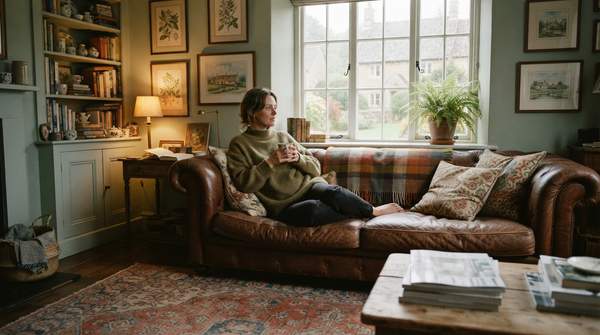
American homes run toward openness: big rooms, high ceilings, clean lines, and space to move. British design pulls in the opposite direction, and that tension is precisely its appeal. The look is built on smaller, cozier rooms, layered patterns, and a sense of history you can feel in the walls. For American readers, the style offers what open-plan living often lacks: intimacy, accumulation, and the feeling that a home was made over generations rather than installed in a weekend. And crucially, you can recognize it in the wild—because it announces itself through a handful of repeatable, identifiable elements rather than a single formula.
The Enduring Appeal of British Design in American Homes
Ask design professionals what defines British interiors and the answer tends to circle the same qualities. The London-based studio Elicyon characterizes British interior design as an emblem of "timeless elegance," prized for its "understated luxury, refined sophistication, and a timeless aesthetic that transcends passing trends." That heritage is not decorative shorthand; it draws on the UK's extensive architectural history, which lends British homes a layered character that newer American housing stock often cannot replicate. The appeal, in other words, is partly an appeal of age itself—of rooms that carry evidence of the past rather than erasing it.
What makes the style travel so well, though, is its flexibility. The design consultancy Caulder Moore argues that British design's "very elusiveness" is what gives it global cultural appeal: it is not a single entity but a family of expressions that can run "the gamut from traditional to modern whilst remaining uniquely, distinctively, and immediately recognisably British." That adaptability matters for American adopters, because it means the look can be translated into a Manhattan apartment or a suburban ranch house without losing its identity. You do not need a Georgian townhouse to make it read as English; you need the right vocabulary of elements, arranged with intention.
The contrast with American conventions sharpens the appeal. Where American interiors favor bold colors, graphic patterns, and striking modern artwork to make a statement, as Elicyon describes, British rooms tend to whisper. They reward slow looking: a patterned wallpaper here, a worn armchair there, books stacked with care. The American eye, trained on open plans and statement pieces, experiences that restraint as romance. It is the difference between a room that performs for guests and a room that seems to have been living its own quiet life for decades before you arrived.
There is also a commercial dimension that keeps the style in front of American buyers. Caulder Moore notes that British brands are well placed to leverage British design precisely because they recognize how "eminently exportable and desirable" it is for an international audience. The aesthetic survives the journey across the Atlantic intact, which is why it keeps reappearing in American shops, hotels, and screens rather than fading between trend cycles.
Cultural Roots of American Fascination
Popular media has done much of the recruiting. Writing in House & Garden, Nicky Rampley-Clarke notes that Americans "continue to be beguiled by romanticised takes on English homes in the likes of Downton Abbey, Bridget Jones's Diary and The Holiday." These are not design documentaries; they are fantasies of a certain kind of domestic life, and they have made the English interior a shorthand for warmth, tradition, and a life less streamlined. The Bridget Jones entry is telling, because it is not a stately home at all—it is a "frazzled English woman" aesthetic, charming precisely because it is imperfect and lived-in.
The Holiday is the clearest case. Rampley-Clarke points to the Surrey Hills cottage in that film—directed by American Nancy Meyers—and asks whether it makes Americans want to "swap open-plan living and clean lines with open fireplaces and low ceilings each and every Christmas." The question answers itself: the cottage is the anti-open-plan, a warren of small rooms that feels protective rather than cramped. That an American filmmaker built the fantasy makes it doubly effective; Meyers knew exactly which buttons to press for her home audience.
Commerce follows culture. Rampley-Clarke reports that Firmdale Hotels now operates three design-led properties in New York on the strength of its playful take on British style, while Carole Bamford, the founder of Daylesford, launched an online shop for US customers and has championed Britishness with pop-ups in the Hamptons and Palm Beach. Americans can now sleep in, shop for, and holiday inside the aesthetic they first encountered on screen. The design event Rooms with a View, held in Connecticut, has even devoted its showcase to "The Enduring Influence of British Design"—evidence that the fascination is institutional, not incidental.
Underneath the media and the marketing is a deeper difference in housing philosophy. Plan7Architect's comparison of American and British home design observes that the British "prefer a more cosy living atmosphere," tolerate smaller spaces with eclectic architecture, and prefer to renovate rather than tear buildings down and start from scratch. American design, by contrast, incorporates larger rooms and higher ceilings with more freedom of movement. For Americans raised on the latter, the former reads as comfort rather than constraint. The British habit of renovation over demolition also means rooms accumulate history—old beside new, one era layered on another—which is exactly the texture American viewers respond to in those romanticized screen cottages.
Identifying British Design Elements
The table below gathers the elements the evidence supports most clearly and contrasts each with the typical American approach. Use it as a field guide: when you walk into a room and something feels "English," it is usually one of these at work.
| British Design Element | Key Characteristics & Purpose | Contrast with Typical American Approach |
|---|---|---|
| Patterned wallpaper | A classic English element; one designer's room featured wallpaper designed by architect George Gilbert Scott and produced by Morris & Co., layered with Delftware plates and a check-upholstered armchair to build a cozy, collected feel. | American interiors more often use bold color and graphic patterns as statements; British pattern is quieter, heritage-rooted, and meant to envelop rather than announce. |
| Canopy beds | Traditionally ornate—dark carved wood and silk swags—but now appearing in contemporary iterations, such as designer Beata Heuman's sweeping canopy in deep blue linen with fringed trim, matched to the headboard to draw the eye upward. | American bedrooms typically favor cleaner, lower profiles; the canopy adds verticality and a sense of ceremony absent from most US bedroom design. |
| Layered books and curated decor | Books housed in purpose-built shelving, displayed as part of the room's texture; House Beautiful's designer commentary emphasizes "lots of books" as a defining feature of English-style rooms. | American styling tends toward fewer, bolder objects; British rooms accumulate and curate, favoring lived-in density over minimalism. |
| Skirted storage | Fabric-skirted cabinetry appears in British homes where Americans would use closed cabinetry, softening utility spaces like mudrooms and laundry rooms. | In the U.S., mudrooms and laundry rooms typically get hard, closed cabinetry; the skirted version trades sleekness for softness. |
| Overall cozy, eclectic layout | Smaller rooms, eclectic architecture, and a preference for renovation over demolition create an intimate, historically rooted atmosphere. | American homes favor larger rooms, higher ceilings, and open-plan freedom of movement. |
Two qualifications keep this guide honest. The elements above are characteristic of popular British styles, not an exhaustive catalog of British design. And the evidence here comes from published commentary by designers and design writers, not from original interviews or case studies, so treat the table as a well-supported starting vocabulary rather than a rulebook.
The wallpaper row deserves the closest reading, because it shows how the elements interlock rather than standing alone. In the room House Beautiful profiled, the designer paired the Morris & Co. wallpaper with Delftware plates flanking the chimney breast, an armchair upholstered in Prince of Wales check, and a bookcase designed specifically for the space. No single item carries the look; the coziness comes from the accumulation. That is the practical lesson for any American room: one element is a nod, three working together is a style.
The canopy bed, meanwhile, shows how the style evolves without losing its identity. House & Garden's Arabella Bowes notes that most people associate canopy beds with "dark, carved wood and ornate swags of silk," yet contemporary versions—like Heuman's linen canopy—demonstrate how modern the look can be. The element survives; only its ornamentation changes. Laura Marino, an American transplant living in London and founder of Studio L London, told House Beautiful that "the key to keeping it quintessentially English is combining curation and intention: how materials, colors, and patterns work together in a carefully tailored way." The style, in other words, is less about any one object and more about how deliberately the objects converse.
Embracing British Charm in Your Home
To incorporate British design elements, focus on creating a layered, cozy atmosphere through patterned textiles, curated decor, and specific furniture pieces like canopy beds. That is the decision: choose one or two elements—a Morris-style wallpaper, a skirted storage piece, a canopy bed in a modern fabric—and let them do the layering work, rather than renovating wholesale. The evidence consistently points to layering, not scale, as the mechanism: small rooms feel cozy because of what is in them, not because of their dimensions.
The measurable indicator of success is a noticeable shift toward a more inviting, historically-rooted, and personalized aesthetic in your living spaces. If a room that once read as open and neutral now feels enveloping and collected—pattern on the walls, books on the shelves, fabric where there was hard cabinetry—the translation has worked. Start with the wallpaper; it is the single element the evidence most consistently ties to the cozy, layered English look, and it is the easiest to test on one wall before committing to a room.
Sources
- BRIDGING STYLES: EXPLORING the NUANCES of BRITISH and AMERICAN INTERIOR DESIGN — Elicyon
- What are the characteristics of British interior design? — Caulder Moore
- Why is British design so enduringly popular in American homes? — House & Garden
- American home design vs British home design — Plan7Architect
- 7 Secrets From British Designers That Make Any Home Feel English-Countryside Cozy — House Beautiful
- Five canopy beds that demonstrate how modern the look can be — House & Garden