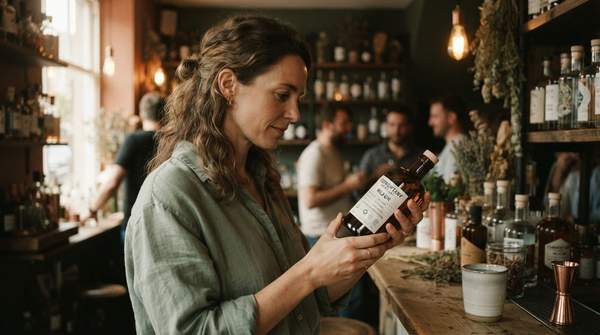
Choosing a drink that matches your values comes down to four words you can look for before you buy: B Corp, carbon-neutral, biodynamic, and organic. That's the practical heart of conscious consumption at the bar. The mindful drinking movement has already taught many of us to ask what's in the bottle; the next question is just as important — how it got there. Here's how I think about it, and how you can too.
The Rise of Mindful Drinking and Conscious Choices
Social drinking has quietly transformed. As the non-alcoholic aperitif maker De Soi describes it, the emergence of non-alcoholic spirits is "not just a fleeting trend but a robust movement towards more inclusive and health-conscious beverage choices," one that offers "the complex flavors and ceremonial feel of traditional spirits without alcohol." Where a zero-proof option once meant a sweet, kid-friendly juice, today's alcohol-free drinks feature botanicals, functional ingredients like adaptogens, and creative garnishes, as writer Marc Josef Delos Santos chronicles in the history of cocktails and mocktails.
The people driving this are not a narrow demographic. De Soi's account of the category spans millennials to older adults — health-conscious consumers, or people simply cutting back for their own reasons, who want a drink that feels grown-up without the alcohol. Barriers to a no- or low-alcohol lifestyle are falling as sober bars gain popularity and non-alcoholic beers, wines, and spirits become widely available.
Beyond Wellness: Connecting Mindful Drinking to Environmental Sustainability
Here's where I'd argue the mindful drinker has an unfinished thought. We've learned to be mindful of our bodies. But the environmental nonprofit David Suzuki Foundation, in its guide to sustainable liquor, notes that spirit production carries real environmental weight — from the crops grown for distillation to the emissions created by production itself. Spirit producers worldwide, the Foundation observes, are "taking steps to reduce their environmental impacts," from organic certifications to carbon-neutral production, much as beer went through its own "green" revolution.
The same logic that steers you toward a non-alcoholic botanical spirit can steer you toward one produced responsibly. What you choose to sip sends a signal about how it was made. And unlike with beer or wine, the Foundation cautions, it can be harder to find out whether your spirit uses sustainable sourcing — which means the label in your hand, and the brand's website, deserve a closer look.
Your Conscious Consumer Checklist for Spirits and Non-Alcoholic Alternatives
Before your next purchase, scan the bottle and the producer's site for these four markers. They turn a vague value — "sustainability" — into something verifiable.
| Criterion | What it means | Why it matters for spirits and non-alcoholic spirits |
|---|---|---|
| B Corp | Certified B Corporations uphold rigorous standards of social and environmental performance, accountability and transparency, per the David Suzuki Foundation's label guidance. | Signals a holistic commitment to ethical business practices beyond the liquid itself — dozens of B Corp spirit brands exist. |
| Carbon-neutral | A company has measured its carbon emissions and offset them through various initiatives, according to the Foundation. | Indicates efforts to mitigate the environmental footprint of production. |
| Biodynamic | An ecological, ethical farming approach; the Foundation notes biodynamic whisky and brandy are on the rise, though it's more common in wine. | Emphasizes soil health, biodiversity, and natural cycles, often exceeding organic standards. |
| Organic / non-GMO | Ingredients grown without synthetic pesticides, fertilizers, or genetic modification. | Addresses the sourcing of raw crops — a real factor when even vodka's potato base is climate-vulnerable. |
The Foundation is candid that not every bottle announces its virtues: some feature an ecolabel, some retailers group their "green" products, and for the rest, you may need to do your own research. That research is exactly what this checklist is for.
B Corp Certification: A Holistic Approach to Ethical Business
Of the four markers, B Corp is the broadest. It certifies the company, not just the ingredient — governance, workers, community, environment, and customers all figure into the assessment. The standard is demanding enough that the David Suzuki Foundation describes B Corp brands as upholding "rigorous standards of social and environmental performance, accountability and transparency."
And yes, non-alcoholic producers are earning it. Beyond Alcohol Ltd, the UK company behind Three Spirit's non-alcoholic drinks, has been a Certified B Corporation since July 2022, according to B Lab's certification directory. B Lab's published assessment shows the company earned an overall B Impact Score of 83.9, above the 80-point certification threshold, while the median score for ordinary businesses completing the assessment is 50.9. For a mindful drinker, that's a brand whose rituals and complex flavors come with third-party-verified operations behind them.
Carbon Neutrality: Reducing Environmental Footprint
Carbon-neutral, as the David Suzuki Foundation frames it, means a company has measured its carbon emissions and offset them through various initiatives — a claim that indicates real efforts to mitigate the environmental impact of production. Some producers are going further. The Foundation highlights Air Company, which it calls an industry green leader producing a carbon-negative vodka: a patented technology mimics photosynthesis by capturing carbon dioxide and transforming it into alcohol, and for each bottle produced, roughly half a kilogram — one pound — of CO2 is removed from the air. Other vodka brands, the Foundation notes, are sourcing organic and non-GMO crops and setting ambitious carbon-neutrality goals.
One honest caveat from the Foundation's own framing: an on-bottle carbon claim is a starting point, not a full audit. It tells you a company is measuring and acting; the depth of that action lives in the brand's published details.
Biodynamic and Organic: Sustainable Sourcing Practices
Biodynamic farming treats the farm as a single, self-sustaining organism — an ecological and ethical approach that emphasizes soil health, biodiversity, and natural cycles, and often exceeds organic standards. It's most established in wine, but the David Suzuki Foundation reports that biodynamic whisky and brandy are on the rise. Organic and non-GMO claims, meanwhile, get at the raw materials: crops grown without synthetic pesticides, fertilizers, or genetic modification. That matters more than it might seem — the Foundation points out that potatoes, a classic vodka base, are among the crops most vulnerable in a changing climate.
Making Informed Choices: Your Next Step in Conscious Consumption
Consumers should actively seek out and prioritize spirit and non-alcoholic brands that display recognized sustainability certifications or transparently communicate their ethical sourcing and production practices. The check is simple and repeatable: the presence of B Corp, Carbon-Neutral, Biodynamic, or Organic labels on product packaging or brand websites. If you find none of the four — and no plain-language explanation of sourcing — that silence is itself information. Mindful drinking asked what's in your glass; conscious consumption asks how it reached your hand. Both questions, asked together, make for a better pour.
Sources
- Non-Alcoholic Spirits: Social Drinking Revolution — De Soi
- From Spirits to Zero-Proof: The Story Behind Cocktails and Mocktails — Cut Above Spirits
- Sustainable liquor explained — David Suzuki Foundation
- Beyond Alcohol Ltd - Certified B Corporation - B Lab — Bcorporation