Embarking on the journey of home fermentation can be a deeply satisfying experience, but choosing the right tools is paramount for both beginners and seasoned enthusiasts. The market offers a variety of primary fermentation vessels, each presenting distinct advantages and trade-offs. Understanding these differences in ease of use, material safety, long-term durability, and practical batch capacity is key to equipping your home fermentation setup for consistent, safe, and delicious results.
This guide will help you navigate the options, from traditional crocks to modern glass jar systems, enabling you to make an informed decision that aligns with your skill level, safety preferences, and fermentation goals.
Understanding Fermentation Vessel Types
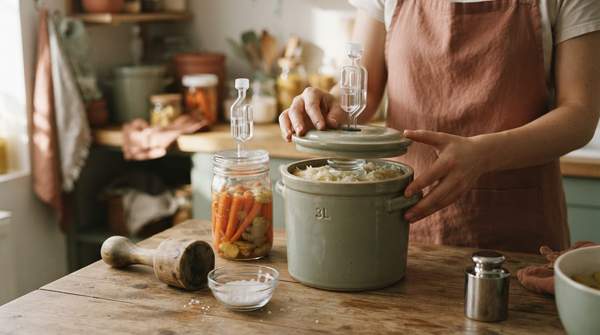
When considering home fermentation, you'll primarily encounter two main categories of vessels: traditional ceramic crocks and versatile glass jars, often enhanced with various sealing and weighting systems. Each type brings its own set of characteristics to the fermentation process.
Traditional crocks, frequently made from stoneware, are designed for larger-scale projects like fermenting pickles and sauerkraut, as noted by the Oregon State University Extension Service. These vessels often feature thick sides, which Ogusky Ceramics explains are beneficial for temperature regulation and contribute to their overall durability. The "open crock" method, endorsed by fermentation expert Sandor Katz, is described as a simple and straightforward approach to fermentation, making these crocks appealing for those who appreciate traditional methods.
Glass jars, particularly wide-mouth canning jars, are a popular and accessible choice for home fermenters. MakeSauerkraut highlights their affordability and transparency, which allows for easy observation of the fermentation process as it unfolds. Twice as Tasty points out their versatility, capable of holding volumes ranging from small test batches to larger "bumper crops." The growing interest in jar fermentation has spurred the development of specialized weights and airlocks designed to fit standard Mason jars, enhancing their functionality and making them adaptable for various recipes and vegetable combinations.
Comparative Fermentation Vessel Chart
The following chart details key home fermentation vessel types, comparing them across ease of use for beginners, material safety, durability, and typical batch capacity.
| Vessel Type | Ease of Use (Beginner-Friendly) | Material Safety Considerations | Durability/Lifespan | Typical Batch Capacity |
|---|---|---|---|---|
| Traditional Ceramic Crocks (Open) | Utilizes the 'open crock' method, described as simple and straightforward. | Stoneware crocks are made with thick sides and fired to a very high temperature, using non-toxic materials. | Often described as heirloom-quality, with thick sides for temperature regulation. | Designed for fermenting pickles and sauerkraut, often implying larger batches. |
| Glass Jars (with various sealing/weight systems) | Inexpensive, clear for observation, and easy to experiment with various recipes. | Plastic lids used with DIY airlocks may contain BPA, requiring care to prevent brine contact; glass itself is generally safe but needs light protection. | Glass jars are generally durable, though they should be kept out of light. | Can hold volumes from small test batches to bumper crops, commonly quart (liter) sizes. |