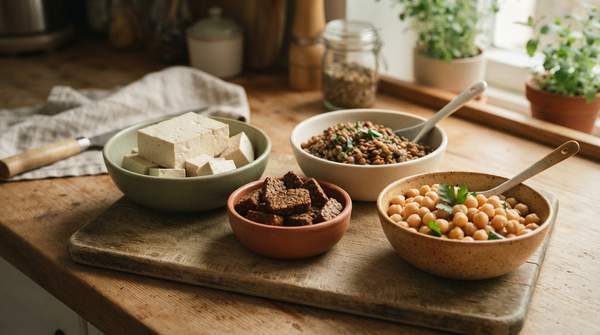
Deep savory flavor does not belong to meat. It belongs to chemistry, and that chemistry is everywhere in the plant kingdom. Umami — the taste we experience when glutamate, 5′-inosinate or 5′-guanylate land on our tongues — can be built deliberately in vegetarian and vegan cooking by choosing the right ingredients and cooking them the right way. Here is the short version: reach for glutamate-rich vegetables, seaweeds and fermented soy foods, pair them with guanylate-carrying mushrooms, and use heat to concentrate what is already there.
The Science of Savory: What is Umami?
Umami has a birthdate. As Joris Schildknecht recounts for the Vegan Academy, the Japanese chemist Kikunae Ikeda identified the taste in 1908 while studying the flavor of kombu seaweed. What he was chasing was glutamate — an amino acid that occurs naturally in many foods. A scientific review of umami research published through the National Center for Biotechnology Information identifies three umami substances in total: glutamate, 5′-inosinate and 5′-guanylate.
Why do we taste it at all? Each basic taste carries a physiological signal, that review explains: sweetness signals energy-rich sugars, while bitterness often signals poison. Umami, according to the nutrition educators at Delish Knowledge, suggests the presence of amino acids and proteins. When we taste it, saliva flow increases and our brain is told we are likely eating protein, prompting increased protein enzyme production. In other words, umami is your body's protein detector.
One clarification, since it comes up constantly: MSG, or monosodium glutamate, is a popular flavor enhancer precisely because it delivers the same glutamate that plants produce on their own. This guide sticks to naturally occurring sources — but chemically, your tongue does not distinguish between the compound in a tomato and the compound in a shaker.
Plant-Based Umami Powerhouses: Ingredients and Compounds
The glutamate list for plants is longer than most cooks expect. Delish Knowledge places glutamate in tomatoes, onions, kombu, asparagus, soy sauce, miso paste, broccoli, peas, mushrooms and beets. The scientific review goes further on seaweed: kombu and nori contain glutamate in very high content — which is exactly why Ikeda found his answer in a kombu broth.
Mushrooms deserve their own sentence, because they work differently. They carry 5′-guanylate rather than being primarily glutamate sources, and shiitake in particular is what the Vegan Academy calls an umami powerhouse. Then there are the fermented soy foods — miso and soy sauce — which the same source describes as packed with umami. Sun-dried tomatoes also anchor plenty of umami-forward plant-based cooking; Courtney Davison's recipe collection at Forks Over Knives pairs them with mushrooms and miso soups repeatedly.
Plant-Based Umami Sources and Enhancement Guide
Use this table as your shopping and cooking shortcut. Each row pairs a category of ingredients with the compound that drives its savoriness and the technique that best unlocks it, so you can pick one item from a glutamate row and one from a guanylate row, then apply the matching method.
| Ingredient Category | Example Ingredients | Primary Umami Compound | Best Cooking Method |
|---|---|---|---|
| Vegetables | Tomatoes (including sun-dried), onions, asparagus, broccoli, peas, beets | Glutamate | Roast to break down natural sugars and intensify savoriness; slow-cook onions until deeply caramelized |
| Fungi | Mushrooms, especially shiitake | 5′-guanylate | Roast, or raise the cooking liquid quickly through 60–70°C to produce more 5′-guanylate |
| Fermented soy foods | Miso, soy sauce | Glutamate | Stir into sauces, broths and marinades as a seasoning layer |
| Sea vegetables | Kombu, nori | Glutamate, in very high content | Steep in hot water or simmer in broths to release it into the liquid |
The logic of the table is simple: know which compound an ingredient brings, and you know what job it does in the dish. Vegetables and fermented soy foods supply glutamate; mushrooms supply guanylate; seaweed supplies glutamate in concentrated form. The technique column then tells you how to get the most from each before it hits the plate.
Unlocking Umami: Essential Cooking Techniques
Heat is your first tool. The culinary instructors at Le Cordon Bleu's Malaysian academy teach that roasting vegetables like mushrooms, onions or tomatoes breaks down their natural sugars and intensifies their umami — the principle behind roasted tomato sauces and caramelized mushroom ragù. The same logic applies to onions cooked low and slow until their sugars and savory depth concentrate into something almost meaty.
Mushrooms reward precision. The umami research review offers a specific tip: in cooking, the temperature of the water containing 5′-guanylate from the mushroom should be quickly increased to 60–70°C to produce more of it. A quick pass through that range, rather than a long lukewarm warm-up, works in your favor.
Smoke is the wildcard. Several accomplished vegetarian cooks shared their tricks with Joe Sevier at Epicurious, and one was blunt: "Smoke gives food tons of umami." Their suggestions include smoked salt and maple syrup to make mushrooms taste like bacon, smoked paprika in vegan chili, and lapsang souchong tea used as a brine for soaking tofu or ground into a pastrami-style dry rub.
Layering for Maximum Flavor: The Synergy Effect
Here is where cooking becomes composition. Delish Knowledge notes that we experience umami with glutamate, inosinate and guanylate — or a combination of them. That word, combination, is the whole secret. A dish built on one umami source tastes savory; a dish built on two different ones tastes deeper, because the amino acids and nucleotides are acting on your receptors together.
Picture a hypothetical vegan ragù to see the layering in action — this is an illustration of the method, not a recipe. Roast your tomatoes first, breaking down their sugars and concentrating their glutamate. Add mushrooms and bring them quickly through that 60–70°C range to develop their guanylate. Finish with a spoonful of miso or a splash of soy sauce for a second glutamate layer. Each element comes from a different row of the table, and each brings a different compound to the bowl.
The same architecture works anywhere: kombu steeped into a broth, mushrooms roasted alongside it, miso stirred in at the end. One glutamate source, one guanylate source, one technique per ingredient. That is the entire framework — and it is why this guide gives you building blocks rather than recipes, so you can apply the pattern to any dish you already make.
Mastering Umami: Your Path to Flavorful Plant-Based Meals
Home cooks can consistently create deeply savory and satisfying plant-based meals by strategically combining glutamate-rich and ribonucleotide-rich ingredients with appropriate cooking techniques. You do not need meat, and you do not need MSG — you need tomatoes or kombu alongside mushrooms, heat applied with intention, and a fermented finish.
Start with your next soup, sauce or stir-fry: pick one ingredient from a glutamate row of the table, one from the fungi row, and cook each using its recommended method. The measure of success is the enhanced depth of flavor and increased satisfaction reported by diners when consuming plant-based dishes prepared using these principles. When the people at your table ask what changed, you will know exactly which compound to thank.
Sources
- Umami & Kokumi — Vegan Academy
- Umami the Fifth Basic Taste — PMC
- Plant-Based Umami: The Secret to Creating Delicious, Vegan Food - Delish Knowledge
- What Is Umami? The 10 Best Plant-Based Sources — Forks Over Knives
- Blog - Mastering Umami Without Meat: Plant-Based Flavour-Building Techniques — Cordonbleu
- Umami-Boosting Secrets From 5 Great Vegetarian Cooks — Epicurious