Visible mending lets you repair a garment by hand and leave the repair on show, turning stitches and patches into part of the design. Three techniques cover most everyday repairs: Sashiko-style patching for reinforcing worn areas with patterned running stitches, woven darning for rebuilding a hole with new threads, and decorative patching for covering damage entirely. Here is how to match the technique to your garment, gather the supplies, and make your first mend.
Introduction to Visible Mending
Instead of hiding wear and tear, visible mending highlights it, treating stitches, patches, and repairs as part of the garment itself. As fabric retailer Core Fabrics explains in its beginner guide, the process is simple and requires no advanced hand-sewing skills or specialized tools — with just a needle and thread, you can start repairing clothes and extending their life.
The practice draws on traditions like Sashiko, a Japanese style of hand stitching whose name means "little stabs." Practitioners describe it as a technique that began as a practical way to repair textiles or add warm layers to working garments, using small repeating stitches that form patterns often inspired by nature. Mending advocate Tiffany Goff-Smith frames the broader practice as an act of sustainability and self-sufficiency: by learning slow stitching and darning, you can breathe new life into beloved garments, reduce waste, and embrace slow fashion.
Choosing Your Mending Approach
Before picking a stitch, decide on your overall strategy relative to the damage. Embroidery artist Erin Eggenburg, writing for Wrenbird Arts, lays out three distinct approaches to any repair, and the style of mending you need often reveals itself when you study the fabric and the rips.
- Stitch the tear directly. Use stitches to stabilize the damaged area without adding any new fabric, reinforcing the original material rather than covering it.
- Patch from underneath. Attach a piece of fabric to the underside of the rip, fortifying the area while leaving the original surface visible.
- Patch over the top. Cover the rip completely, obscuring the original tear in its entirety and replacing it with a new design element.
A clean rip with strong surrounding fabric may only need direct stitching, while a frayed hole or stubborn stain calls for an under-patch or a full top patch. This choice — reinforce, fortify, or cover — is the first decision, and the technique you select flows from it.
Visible Mending Technique Selector
Use this comparison to match your repair need to the right technique. Each method differs in the damage it suits best, the supplies it requires, and the look it produces.
| Technique | Best for (Fabric/Damage) | Required Supplies | Aesthetic Outcome |
|---|---|---|---|
| Sashiko-style patching | Reinforcing worn areas, covering holes, or layering for warmth — especially in sturdy garments like denim, where the strong thread spreads stress and makes the repair durable. | Fabric scraps, fabric scissors, pins or safety pins, a Sashiko or long embroidery needle, Sashiko or embroidery thread, a thimble, and optional marking chalk or an erasable pen. | Visible, often geometric or linear patterns that transform holes into decorative statements; stitches can be minimal or bold. |
| Woven darning | Repairing holes in knitted and woven fabrics, particularly when you want to rebuild the fabric structure itself. | Needle, mending yarn or thread suited to the fabric, and optionally a darning mushroom or egg for support. | A new, integrated woven surface that can blend with the original fabric or stand out as a contrasting design element. |
| Decorative patching | Completely covering tears, holes, or stains, especially when the surrounding fabric is too damaged to stitch directly. | Fabric for the patch, scissors, pins, needle, and thread — the same general patching supplies as Sashiko. | A distinct design element that fully obscures the damage; the look follows general patching principles and invites creative expression. |
The framework is straightforward: a worn-thin knee or elbow points to Sashiko reinforcement, a clean hole in a knit points to darning, and damage you want gone entirely points to a top patch.
Step-by-Step: Sashiko-Style Patching
Sashiko stitching transforms holes into decorative statements, and it is a beginner-friendly place to start. The tutorial from mending supplier Aboderie walks through the full process.
Gather your supplies: the damaged item, fabric scraps, fabric scissors, pins or safety pins, a Sashiko needle or long embroidery needle, Sashiko or embroidery thread, a thimble, and optionally tailor's chalk or an erasable pen.
- Cut your patch. Cut a piece of fabric that covers the hole plus a few centimetres around the edge. To stop the edges fraying, overlock them, use a zigzag stitch, or cut with pinking shears.
- Pin the patch inside the garment. Pin the patch to the reverse of the garment, through both layers of fabric, centred over the hole.
- Mark your pattern. Use a ruler and tailor's chalk to draw a neat grid of roughly 1 cm squares centred over the hole. Stitcher Jo Boyne recommends marking a grid of dots when you are first starting, even though experienced menders often skip it.
- Stitch. Work small, even, repeating running stitches along your marked lines or grid. The repeating stitches form the pattern and, layer by layer, reinforce the worn fabric beneath.
Practitioners note that the humble running stitch is what makes Sashiko strong: the dense, repeating stitches spread stress across the patch and the garment, which is why the technique suits high-wear spots like the knees of jeans. The repetitive stitching is also described by sewists as meditative and calming — part of the craft's appeal rather than a chore.
Getting Started with Woven Darning
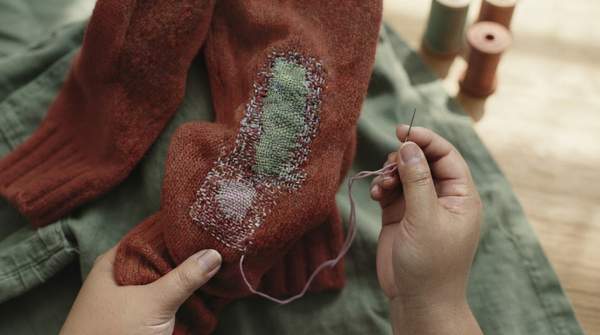
Where Sashiko reinforces fabric, darning rebuilds it. Woven darning involves weaving new threads horizontally and vertically across a hole to create a new fabric surface, with the stitches anchored in the stable fabric around the hole's edge. It suits both knitted and woven fabrics, and it is the technique to reach for when the damage is an actual hole rather than a thinning area.
The supply list is short: a needle, mending yarn or thread suitable for the fabric, and potentially a darning mushroom or egg to support the work. On knits, wool or mending yarn works well because it keeps the repair soft and flexible. The interlaced horizontal and vertical threads form a patch that is structurally part of the garment, and your thread choice determines the look — match the original yarn to blend the darn in, or choose a contrasting colour to make the repair a deliberate design feature.
Embracing Decorative Patching
Decorative patching is the "patch over the top" approach: a piece of fabric applied over the damage to obscure the original tear completely. It is the most forgiving of the three techniques because the state of the fabric underneath matters less — the patch simply covers whatever is there, whether a rip, a worn hole, or a stain that will not lift.
It uses the same general supplies as Sashiko patching — fabric, scissors, pins, needle, and thread — and the same preparation: cut the patch generously beyond the damage, finish its edges against fraying, and pin it securely before stitching. The aesthetic outcome follows general patching principles, which leaves plenty of room for creative expression: a bold printed scrap can turn a torn knee into the garment's focal point, while a matching fabric patch can read as a quiet, near-invisible mend. Because the patch fully covers the damage, this is also the approach to choose when the surrounding fabric is too fragile to stitch directly.
Start Your Mending Journey
Choose a visible mending technique — Sashiko, darning, or patching — that aligns with your garment's damage and your personal style, gather the necessary supplies, and begin the repair process. A worn knee wants patterned reinforcement, a hole in a sweater wants a woven darn, and damage you want gone wants a top patch. The measurable indicator of success is a completed visible mend on a garment, demonstrating extended life and a personalized aesthetic — one repaired piece, worn again, with the mend on show.
Sources
- Sashiko + Denim = True Love — wrenbirdarts
- The Art of Mending — Southern Gals Designs
- How to Do Sashiko Stitching: Easy, Beautiful Visible Mending — Aboderie
- Sashiko Stitching - Using Sashiko Mending To Repair Clothes ⋆ A Rose Tinted World