You do not need a sunroom, a renovation budget, or a green thumb to bring the health benefits of nature into your home. Biophilic design—the practice of weaving natural elements into indoor spaces—rests on three core categories, and each one can be applied room by room with modest, decor-level changes. According to a peer-reviewed review of biophilic interior environments, connecting with nature supports relaxation, stress relief, lower blood pressure and heart rate, improved cognitive functioning, more positive emotions, and reduced fatigue and sadness. This guide translates that research into a practical checklist covering your living room, bedroom, kitchen, and bathroom.
Introduction to Biophilic Design: Connecting with Nature Indoors
Biophilic design is not an aesthetic trend so much as a corrective. As design consultancy Terrapin Bright Green explained in its influential report 14 Patterns of Biophilic Design, the approach provides a framework for incorporating "a rich diversity of strategies into the built environment"—in other words, for rebuilding the human connection to nature that modern buildings tend to sever. The payoff is measurable rather than merely decorative.
The Science in Design implementation guide frames the approach as science-backed: nature-inspired spaces measurably reduce stress, support brain health, and improve the well-being of occupants. A design-sector review published by Shepley Bulfinch reaches a similar conclusion, citing research by Zhong, Schröder, and Bekkering (2021) that elements such as natural lighting, greenery, and organic textures have been shown to reduce stress, enhance cognitive function, accelerate healing, and promote overall well-being. Writing in the Los Angeles Times, Sara Kitnick makes the mechanism concrete: when you look at plant life or natural materials, your parasympathetic nervous system engages. "You relax," she writes. "It's not magic. It's biology."
The Three Core Categories of Biophilic Design and Their Benefits
Understanding the three categories helps you see why the checklist below works. Nature in the Space is the most direct: it involves the actual, physical presence of nature—plant life, water, animals, and sensory elements like breezes, sounds, and scents, per Terrapin Bright Green's framework. A scientific review of biophilic interior environments describes it simply as creating a visual connection with nature, such as vegetation both outside and inside a residence. The documented benefits include stress relief, lower blood pressure and heart rate, and improved cognitive functioning.
Natural Analogues are indirect evocations of nature: the textures, geometries, materials, colors, shapes, and patterns found in the natural world, without the living thing itself. Here the benefit is subtler but still real. Kitnick reports that using natural patterns and fractal geometries in decor can improve cognitive function and perceived safety—part of why a wood table or a botanical-print textile can shift how a room feels.
Nature of the Space concerns spatial configuration rather than objects. It includes imitating natural processes—such as circadian lighting patterns—and borrowing spatial compositions from nature, like a reading nook that offers a sense of refuge and safety. Together, the three categories address different aspects of the human-nature connection, which is why the checklist draws on all of them rather than prescribing plants alone.
Room-by-Room Biophilic Design Checklist: Living Room & Bedroom
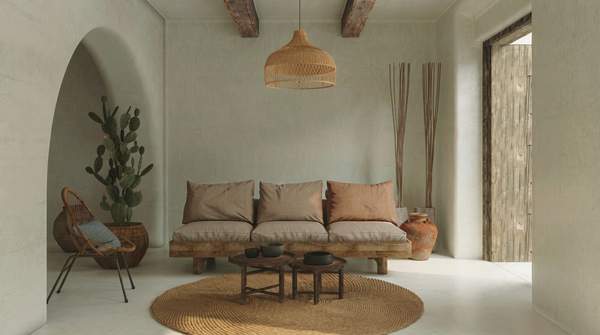
The living room is usually where direct contact with nature is easiest to achieve. Prioritize natural light and views—pull back window coverings and arrange seating so the sightline reaches greenery rather than a wall. Then layer in living elements: even one substantial plant changes the room. The Science in Design guide includes natural light and views, living elements, natural materials, biomorphic forms, nature-inspired color palettes, and sensory connections among its core room-specific considerations.
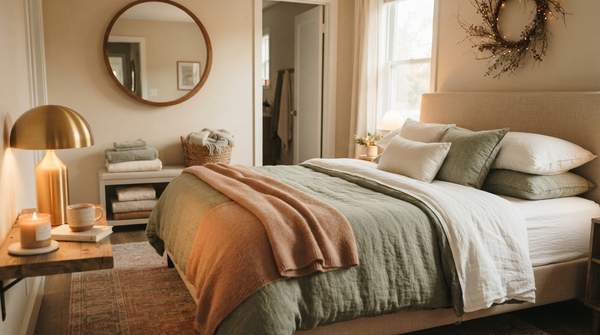
The bedroom is where the "Nature of the Space" category earns its keep. The biophilic-interiors review notes that lighting that follows circadian rhythms—warmer, dimmer light toward evening—supports the body's natural processes, and that quality sleep is linked in turn to mental health, neurological function, and the immune system. Position the bed so it feels sheltered rather than exposed, add soft natural materials such as linen or wool, and let a plant or a view of greenery be the first thing you see on waking.
Your Home's Biophilic Design Checklist
Use this table to cross-reference each category of biophilic design with a specific action in each room. Walk through your home room by room, mark which elements are already present, and treat the gaps as your action plan—each intervention below is chosen because it maps onto one of the three categories and its documented benefit.
| Room | Category Applied | Action to Take | Documented Benefit |
|---|---|---|---|
| Living room | Nature in the Space; Natural Analogues | Maximize daylight and views; add living greenery; use natural materials like wood and stone | Stress relief, lower blood pressure and heart rate, improved well-being |
| Bedroom | Nature of the Space | Align lighting with circadian rhythms; create a sheltered, refuge-like bed placement; natural textiles | Supports sleep quality, mental health, and neurological function |
| Kitchen | Nature in the Space; Natural Analogues | Keep herbs or potted plants on the counter; use organic textures and nature-inspired colors; open the window for breeze and scent | Positive emotions, reduced fatigue and sadness, perceived safety |
| Bathroom | Nature in the Space; Natural Analogues | Introduce a water feature or emphasize running water as a sensory element; moisture-loving plants; natural stone or wood surfaces | Relaxation and stress reduction through sound, scent, and natural textures |
Notice the pattern: every room gets one intervention drawn from direct nature, and one from its analogues or spatial character. That is deliberate. A room with a plant but no natural light, or a view but only synthetic surfaces, captures only part of the benefit.
Room-by-Room Biophilic Design Checklist: Kitchen & Bathroom
The kitchen offers the easiest living elements of any room—potted herbs are both practical and genuinely green, which makes them a natural first step for skeptics. Nature-inspired color palettes (earthy tones rather than stark whites) and organic textures in textiles, as catalogued in the MeltFlex room-by-room guide, fall under the natural analogues category and cost little to adopt.
The bathroom, meanwhile, is the one room where a water feature comes almost free. Terrapin Bright Green's framework counts water among the core elements of nature in the space, and the bathroom already centers on it—so the design move is simply to make that presence pleasant: better materials, a plant that tolerates humidity, and a window that opens to breeze and sound. Small spaces handle this easily, and no room is too modest to start.
Low-Cost and Small Space Biophilic Solutions
The most common objection is cost, and the evidence suggests it is misplaced. The Home World Design low-cost guide concludes that small changes—adding plants, using natural colors, and maximizing natural light—can make a significant difference without a large budget, and recommends starting with a few elements and gradually adding more. MeltFlex's guide estimates a basic approach of indoor plants, natural textiles, and rearranging for more natural light at roughly $200 to $500 per room.
In a compact apartment, the advice shifts from adding to choosing. A writer for the MOMIJI Journal puts it plainly: one large leafy plant in a corner or a natural wood bench "can say more than five mini decor items ever will." DIG Interior Design Solutions recommends curved furniture, organic shapes in artwork, and fractal patterns in textiles for small spaces, along with multifunctional pieces that leave room to breathe.
That MOMIJI Journal piece also captures the philosophy of the whole endeavor: "at the end of the day, biophilic design is less about how your home looks and more about how it feels"—something, its author notes, "you can live with, every single day, even in a tiny city flat."
Embrace Nature, Enhance Your Home
Homeowners can significantly improve their well-being and cognitive function by systematically integrating biophilic design principles into their living spaces. The three categories—nature in the space, natural analogues, and nature of the space—give you a complete vocabulary, and the checklist above turns that vocabulary into an assessment you can complete in an afternoon. Nothing in it requires structural work: it is decor, light, plants, color, and arrangement.
The measure of success is not a magazine-ready interior. It is a change you can notice in yourself: better mood, lower stress, and an increased sense of calm and focus at home. If you start with one room—one plant, one rearranged chair facing a window, one warmer bulb for evenings—those are the outcomes to watch for, and they are the reason the science behind this approach keeps pointing in the same direction.
Sources
- Healthy Dwelling — PMC
- 14 Patterns of Biophilic Design — Terrapinbrightgreen
- Science in Design® Biophilic Design Implementation Guide - SCIENCE IN DESIGN
- Six Principles of Biophilic Design - Biophilic Design Elements — Shepley Bulfinch
- Biophilic Design 101: Why Your Home Needs Natural Elements for Better Health — Los Angeles Times
- Biophilic Interior Design: Room-by-Room Guide (2026) — MeltFlex
- The Low-Effort, Low-Cost Biophilic Design Guide — Home World Design
- Biophilic Design in Small Apartments: Easy Ideas to Try - MOMIJI Journal
- Embrace Biophilic Design in Your Compact City Apartment – DIG Interior Design Solutions — DIG Interiordesign