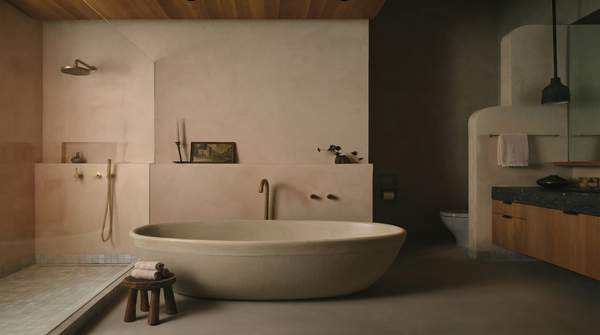
If you are planning a bathroom renovation around 2027, the forecast from interior designers is remarkably consistent: the bathroom is no longer being treated as a purely practical room. Designers interviewed by Veranda, writing in October 2026, describe clients moving away from "purely practical" spaces toward "thoughtfully-designed" rooms, while Decorilla's 2027 trend report and 34 St John's luxury trend report both point to the bathroom behaving "more like a private wellness suite." This article compares the four strongest trends across aesthetic impact, functional benefit, and suitability, so you can match a trend to your space rather than adopting one wholesale.
Personalized Wellness: Creating a Sanctuary
The most ambitious of the 2027 predictions is the shift toward the bathroom as a wellness destination. 34 St John's trend report, authored by Piper Jacobsen in May 2026, frames this as the moment when the bathroom "stops being a functional room with luxury touches and starts to behave more like a private wellness suite." The report cites survey figures it attributes to the NKBA's 2025 research: 72% of designers say bathrooms are growing in size specifically for wellness-focused layouts, and 77% see homeowners taking inspiration from hotels and resorts.
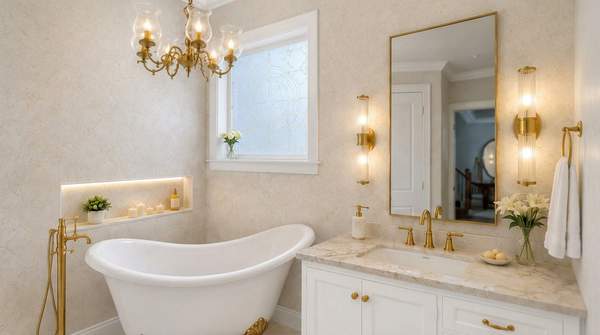
Aesthetically, this trend trades the clinical, hard-edged bathroom for something warmer and more retreat-like. 34 St John's report describes surfaces with "delicate tonal variations and soft movement" that catch light and bring warmth and dimension, alongside a wabi-sabi stone trend rooted in the Japanese philosophy of finding beauty in imperfection — raw textures, organic forms, veining that flows unpredictably, and edges that feel softly weathered rather than sharply machined.
Functionally, the benefit is a dedicated space for relaxation and self-care rather than basic hygiene. The trade-off is space: because designers report bathrooms growing to accommodate wellness layouts, this trend is best suited to primary bathrooms or larger rooms where zones can be created. In a compact footprint, the full expression — separate soaking or steam areas, generous circulation — is harder to achieve, though the warmer material palette travels well to any size.
Bespoke Storage: Function Meets Form
The second trend is the most quietly transformative, because it works in bathrooms of every size. Rachel Cannon, founder and principal designer of Rachel Cannon Limited, told Veranda that she continues to observe a move toward "fully-custom cabinetry in bathrooms, focusing not just on aesthetics but also on how the space is organized and functions." Her reasoning is blunt: even the most stunning bathroom will look terrible behind closed doors if it lacks organization.
Aesthetically, bespoke storage contributes to a clean, uncluttered, sophisticated look. Because the cabinetry is custom, it integrates into the room's design language rather than sitting beside it — the storage becomes part of the architecture rather than furniture added to it. This is the trend that most directly addresses the everyday reality of a bathroom: the bottles, towels, and tools that usually clutter surfaces.
Functionally, the benefit is organization and concealment — keeping essentials out of sight while remaining accessible. The practical advantage for renovators is that customization adapts to the layout you actually have. An awkward alcove, a sloped ceiling, or a narrow vanity wall becomes usable capacity rather than dead space. If your renovation goal is a calmer, tidier room without changing its footprint, this is the trend with the clearest day-to-day payoff, and it pairs naturally with any of the other three directions.