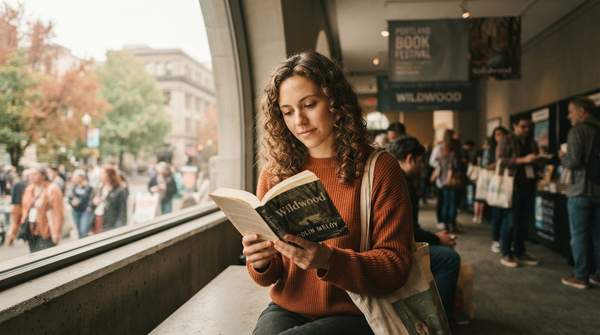
The 2026 Portland Book Festival closed its main day on Saturday, November 7, as a sold-out, city-wide celebration that stretched well beyond the traditional author panel. Organized by the nonprofit Literary Arts and running November 2–8, the festival drew thousands downtown, with its emotional centerpiece a morning panel before 2,700 fans featuring Colin Meloy and Carson Ellis, the husband-and-wife creators of the "Wildwood" fantasy trilogy and its new Laika stop-motion film adaptation.
Portland Book Festival 2026: A Thematic Overview
What distinguished this year's festival was not just who appeared but how the programming was arranged. Reporting from the main day by Amy Wang for Oregon ArtsWatch and Hillary Borrud for The Oregonian/OregonLive, together with the festival's own materials, reveals three distinct currents running through the week: a celebration of a homegrown creative milestone, a platform for nationally prominent literary voices, and a deliberate expansion into music, art, and food across downtown Portland.
The scale was notable. General admission passes sold out for 2026, according to the festival's website, which framed the week as welcoming "readers, writers, artists, musicians, chefs, and storytellers to the heart of Portland." The main day alone spread across 10 stages hosting speaker panels, kids' events, pop-up readings, writing workshops, and vendors at the Portland Art Museum. The festival has grown from a single-day event for most of its existence into a full week, as Meg Cotner noted in Bridgetown Bites, which described it as the largest festival of books and storytelling in the Pacific Northwest.
Thematic Pillars of the 2026 Portland Book Festival
Sorting the reported panels and new activities into categories shows how the pieces fit a coherent curatorial vision rather than a simple lineup. The table below synthesizes the reported highlights into the three pillars that defined the week.
| Thematic Pillar | Key Authors/Events | Significance |
|---|---|---|
| Local Creative Spotlight | The "Wildwood" panel with Colin Meloy and Carson Ellis before 2,700 fans at the Arlene Schnitzer Concert Hall, opened by Mayor Keith Wilson | Celebrated a Portland-set book series and its film adaptation made by Portland-based Laika, positioning a local story as the festival's biggest draw |
| National Literary Voices | Deeshaw Philyaw, Rainbow Rowell, Elizabeth Alexander, Willy Vlautin, Valeria Luiselli, Andrew Sean Greer, Anand Gopal, Ke Huy Quan, and Anthony Hudson | Brought prize-winning and acclaimed authors together around themes of bold women writers, poetics, and intergenerational stories |
| Cultural Expansion | Live music, art, and culinary events throughout the week; "Portland Book Festival After Dark" evening programming; Cover-to-Cover partner events | Transformed a formerly single-day literary event into a week-long, multi-venue downtown celebration with arts and food partners |
Read together, the pillars suggest a festival betting that literature anchors something larger: a civic gathering where a fantasy trilogy, a Syrian war narrative, and a cookbook-inspired dinner all belong to the same celebration of storytelling.
The 'Wildwood' Phenomenon: A Local Story Takes Center Stage
The festival's opening hour belonged to "Wildwood." Mayor Keith Wilson opened the day at 10 a.m. at the Arlene Schnitzer Concert Hall, joking to the crowd, "Has anybody read the book or seen the movie?" He told the audience he had watched the film in St. Johns, the Portland neighborhood where the main characters live and where he grew up, and thanked attendees for contributing to the "renaissance of our extraordinary city."
Literary Arts executive director Andrew Proctor then moderated the panel, calling the first novel of the Wildwood Chronicles "an instant classic." For the next hour, he, Ellis, and Meloy traced how the books and then the movie came to be, aided by a slideshow. The Oregonian's coverage connected the panel to a broader local moment, reporting on Laika's "Wildwood" as a box office hit for Portland indie theaters and noting a Voodoo Doughnut tie-in to the film.
The panel's placement as one of the first events of the day, in the festival's largest venue before its largest reported audience, reflects a deliberate curatorial choice: a Portland-made story, adapted for the screen by Portland-based Laika, offered the festival its most vivid symbol of the city's literary and film industries converging.
National Literary Voices and Thematic Currents
Beyond "Wildwood," the main day showcased a wide literary range. Wang's report for Oregon ArtsWatch highlighted appearances by Deeshaw Philyaw and Rainbow Rowell, Elizabeth Alexander, and Willy Vlautin and Valeria Luiselli, under the thematic banner of bold women, poetics, and intergenerational stories. The panels featured books and one movie released between August 2025 and November 2026, giving the festival a snapshot of contemporary publishing.
Borrud's reporting added further headliners: Pulitzer Prize-winning novelist Andrew Sean Greer discussed his coming-of-age tale "Villa Coco," while Pulitzer Prize and National Book Award finalist Anand Gopal was on the bill to discuss "Days of Love and Rage," his nonfiction account of a small group of men and women in one Syrian city who became opponents of the dictatorship there. Actor and author Ke Huy Quan was interviewed by journalist Dave Miller. At the Portland Art Museum, writer, artist, and former drag clown Anthony Hudson read from "Lamp Black: Plays and Other Grievances," a collection that includes a performance he presented at the museum nearly a decade ago.
Beyond the Page: Festival's Expansion into Arts and Culinary Experiences
The most consequential change was structural. Literary Arts described this year's festival as expanding "beyond the page with dinners, tastings, cocktails, and gatherings inspired by books and storytelling," ranging from intimate cookbook-inspired meals to larger culinary events combining food, music, and performance. Partnerships with the Oregon Symphony, Revolution Hall, Mississippi Studios, the Portland Art Museum, and others framed the week as a reflection of the city's creative community.
Evening programming under the "Portland Book Festival After Dark" banner brought live music, performances, and events throughout downtown, spilling into the South Park Blocks. The festival's plan-your-visit page described additional programming aimed at going "beyond the scope of a traditional reading or author panel," noting past events have included a mock burial, tea ceremonies, and poetry karaoke. Cover-to-Cover partner events did not require a festival pass, with many free and some individually ticketed.
Looking Ahead: The Festival's Evolving Identity
The 2026 Portland Book Festival's expanded, multi-disciplinary format marks a significant evolution, suggesting a future where it functions as a broader cultural anchor for the city. The inference rests on official statements about expanded programming and partnerships, indicating a shift from a single-day literary event to a multi-faceted cultural festival, alongside sold-out passes and thousands of attendees on the main day.
For readers tracking where this goes next, monitor future festival programming announcements for continued integration of non-literary arts and culinary events, and official statements regarding attendance and community engagement metrics. Whether the week-long, city-wide format becomes the festival's permanent identity is the question its 2027 programming will answer.
Sources
- Literary Arts presents the Portland Book Festival
- Portland Book Festival draws thousands to hear from ‘Wildwood’ creators, use tarot for writing — oregonlive
- Portland Book Festival: A day of ‘Wildwood,’ bold women, poetics, and intergenerational stories • Oregon ArtsWatch — Oregon ArtsWatch • Arts & Culture News
- Home - PDX Book Fest
- The 2026 Portland Book Festival Welcomes Food This Year - Bridgetown Bites
- Plan Your Visit - PDX Book Fest