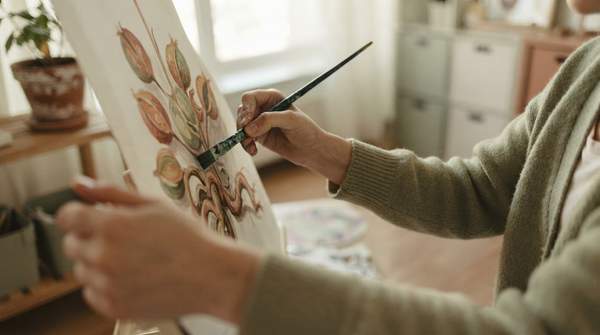
Engaging with art—whether standing before a painting or sketching in a notebook—offers measurable psychological benefits, from reduced anxiety to sharper focus and stronger social bonds. Research in psychology and neuroaesthetics shows these gains are real, distinct depending on whether you view or create, and amplified by personality traits like curiosity and openness. You do not need talent, a studio, or formal training; you need only intention and a little guidance in matching the right activity to the right goal.
Introduction: The Power of Art for Mental Well-being
The evidence is broader than many assume. A World Health Organization report, described by the American Psychological Association, found that art therapy and arts engagement have been shown to reduce symptoms of depression and anxiety, ease pain, help people heal from trauma, protect against cognitive decline, and enhance social cohesion. Music listening alone can foster new neural pathways in adults after a stroke. What makes this moment interesting for the curious reader is the shift from "art is nice" to "art works"—and the growing understanding of which mechanisms produce which outcomes.
Two Pathways to Well-being: Viewing vs. Creating Art
There are two primary routes to these benefits, and they are not interchangeable. As a viewer, you engage in aesthetic experience: receiving, interpreting, and feeling. A study of art exhibitions found that experiences centered on deeply emotional human themes may reduce anxiety and enhance other-oriented feelings—empathy and connection to others' experiences. The mechanism is emotional immersion: when art draws you into human themes, you come out less anxious and more oriented toward others.
As a creator, you engage in expressive activity. A critical review of visual art therapy notes that this process helps people gain self-expression, self-awareness, learning, and personal development, while improving contact, communication, and interaction with others. Importantly, the everyday version of this does not require a licensed therapist: journaling, sketching, dancing in your living room, or listening deeply to music all give the mind space to reset, as the University of Arizona Health Sciences puts it. Neither pathway is superior; they serve different needs at different moments.
How Your Personality Shapes Your Art Experience
Why does one person leave a gallery transformed while another leaves unmoved? The exhibition study offers a compelling answer: participants with higher curiosity and openness traits spent more time engaging with artworks and gave more positive evaluations, reporting stronger emotional reactions and a greater sense of satisfaction and personal enrichment. The researchers concluded that psychological traits define clusters of people who may benefit more from such experiences.
Openness to experience deserves particular attention. It was positively correlated with nearly all evaluation scores in the research, and prior studies identify it as a strong predictor of art appreciation. Crucially, openness is not a passive preference—it reflects active engagement that deepens the aesthetic experience. The encouraging implication: traits like curiosity can be cultivated. Lingering longer, asking questions, and seeking emotionally rich work are behaviors, not fixed gifts.
Your Guide to Art for Mental Well-being
The framework below maps well-being goals to specific activities and the psychological mechanism behind each, drawing on the research above. Find your goal, then choose the matching engagement type.
| Well-being Goal | Engagement Type | Recommended Activity | Psychological Mechanism |
|---|---|---|---|
| Reduce anxiety and stress | Viewing or structured creating | Visiting an art exhibition, especially emotionally rich human themes; pattern drawing or coloring | Aesthetic experience reduces anxiety; structured, repetitive activities calm the mind |
| Improve focus and clarity | Light creating | Doodling or sketching while listening or working | Light creative activity reduces mind-wandering and restores attention without added strain |
| Build social connection | Shared creating | Group dance, music, or shared art-making | Creating together builds belonging and reduces isolation |
| Deepen self-awareness and growth | Expressive creating | Journaling, visual art, symbolic self-expression | Expressive activity fosters self-awareness, reflection, and personal development |
| Support long-term cognitive health | Both viewing and creating | Regular, varied arts engagement | Arts engagement is linked to improved memory and reasoning and protection against cognitive decline, particularly in aging adults |
One nuance from the research on transformation: psychologists studying how art changes people found that works eliciting "small" transformations may be a sweet spot for boosting well-being, while more disruptive "big" transformations—though sometimes uncomfortable—can produce greater personal growth. If you want comfort, choose absorbing work; if you want growth, accept some challenge.
Practical Steps for Integrating Art into Your Life
Start small and specific. If stress relief is the goal, try thirty minutes of coloring or pattern drawing, or visit a local exhibition—no special equipment required. If focus is the goal, keep a notebook for light doodling during meetings or lectures. If connection is the goal, look for group dance, community music, or shared art-making; research suggests dance can be as effective as—or more effective than—other forms of exercise for psychological and cognitive health. If growth is the goal, keep a visual journal or sketch feelings you cannot yet put into words. The University of Arizona Health Sciences emphasizes that you need neither a studio nor special equipment—only participation.
Embrace Art for a Healthier Mind
Integrate regular art engagement, both viewing and creating, into your routine to support mental well-being. The evidence supports this as a complement to—not a substitute for—professional mental health treatment, and the benefits vary with the type of engagement and your individual characteristics. To know whether it is working, monitor personal feelings of stress reduction, improved focus, increased social connection, or enhanced self-awareness after engaging in chosen art activities. Pick one activity from the framework this week, and let your own response be the measure.
Sources
- Art for self-care and mental health — The Whole U
- Art-induced psychological well-being: Individual traits shape the beneficial effects of aesthetic experiences - PMC
- APA
- Role of Art Therapy in the Promotion of Mental Health: A Critical Review - PMC
- How creative arts support mental health in daily life — The University of Arizona Health Sciences